5 Birds With Strange Habits That Are Actually Genius
“Crows are smart” is a starter-pack take. The actually interesting bird genius is happening in species nobody mentions on a tote bag — and it includes lying, kidnapping, password protection, and a chemistry lab strung up on barbed wire.
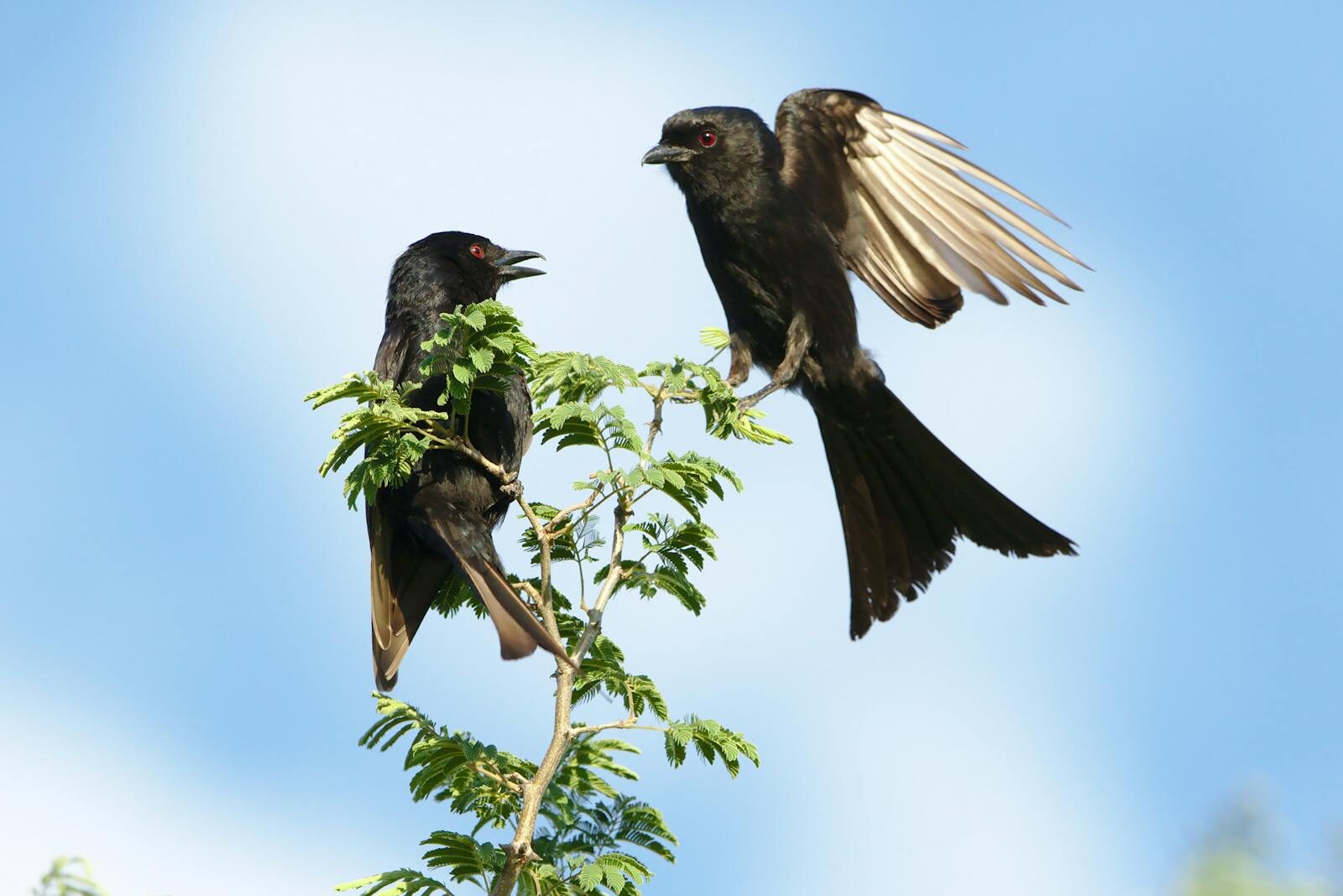
Fork-tailed drongos in the Kalahari fake alarm calls to steal food from meerkats — and switch to mimicking different species when the meerkats catch on
Tom Flower documented this in a 2014 Science paper. A fork-tailed drongo perches above a foraging meerkat group, waits until a meerkat catches something good, then shouts an alarm call. The meerkat drops the food and bolts for cover. The drongo swoops in and eats it.
Up to roughly a quarter of a drongo’s daily food intake comes from this con. The interesting part is what happens when the meerkats start to wise up. Repeat the same fake alarm too often and your target habituates — they stop responding to that specific call. Flower’s experiments showed that drongos switch tactics: they begin mimicking the alarm calls of different species (including the meerkats’ own calls) once their preferred fake stops working. They escalate their lies in proportion to the audience’s skepticism.
This is one of the cleanest documented cases of tactical deception in any non-human species. It’s also probably why everyone in the Kalahari hates the drongo.
Superb fairy-wren mothers sing a “password” to their unhatched eggs that the chicks have to copy in their begging calls — to defeat cuckoos
Diane Colombelli-Négrel and Sonia Kleindorfer published this in Current Biology in 2012, and it remains one of the more cinematic findings in avian behavioral ecology. While incubating, female superb fairy-wrens repeat a specific signature note to their eggs. Embryos hear it through the shell and memorize it. After hatching, the chicks incorporate that signature into their begging calls. Parents preferentially feed chicks whose begging matches.
The reason this exists is the Horsfield’s bronze-cuckoo, which lays eggs in fairy-wren nests. Cuckoo eggs hatch slightly later than fairy-wren eggs, which means the cuckoo embryo doesn’t get enough exposure to the mother’s note to copy it. When the cuckoo chick begs, its call doesn’t quite match. The parents are more likely to abandon the nest.
Worth being precise: the system isn’t infallible. Parents don’t reject mismatched chicks every time — they’re biased against them. But the broader idea is sound. A wild bird is teaching a password to its embryos to defeat a brood parasite. That’s two-factor authentication, evolved.
Loggerhead shrikes impale toxic lubber grasshoppers and leave them on thorns for 1–2 days specifically to let the poison degrade
Shrikes impaling prey is well-known; the second-layer fact is what they do with the lubber grasshopper specifically. Romalea guttata, the eastern lubber, is chemically defended well enough that 21 tested vertebrate species refused to eat it or vomited it back up, and it has killed lizards that tried.
Reuven Yosef, James Carrel, and Thomas Eisner figured out the workaround in 1996. Florida shrikes catch lubbers, impale them, leave them on thorns for one to two days, and come back to eat. The lubber’s chemical defenses degrade post-mortem. The shrike’s larder isn’t (just) a pantry — it’s an outdoor chemistry station for letting the poisons break down so that dinner becomes safe.
The shrikes also do surgical things to the carcass. They preferentially eat the head and abdomen and skip the thorax, which is where the defensive glands concentrate. So you’ve got a small songbird running a two-step protocol: time-based detoxification, plus anatomical avoidance of the toxin reservoir. From a creature smaller than a robin.
White-winged choughs kidnap juveniles from neighboring family groups when they’re short on helpers — and adult helpers in the nest cheat by faking the act of feeding chicks
White-winged choughs are Australian ground-dwellers that live in cooperative family groups. The catch: they physically cannot raise chicks without at least four adult helpers per nest. Pairs alone fail. Trios fail.
Robert Heinsohn’s 1991 paper in Animal Behaviour documented what they do about this. Short-handed groups raid neighboring family groups and kidnap juveniles, integrating them as future helpers. The kidnap victims, once incorporated, eventually help raise the next round of chicks. Bird society, with crime.
It gets stranger. A 1996 follow-up by Christopher Boland, Heinsohn, and Andrew Cockburn showed that helpers in the nest cheat. When the dominant pair isn’t watching, some helpers go through the motions of feeding nestlings but quietly eat the food themselves. So choughs have evolved both cooperative breeding and a parasitic strategy that piggybacks on it, in the same population, with the same individuals switching modes. A tiny avian society that runs on kidnapping, fake parenting, and the surveillance that becomes necessary as a result.
The brown-headed nuthatch — a songbird the size of your thumb — is the only regularly tool-using bird native to North America, and it uses a piece of bark to pry off other bark

Of the roughly 10,000 bird species on Earth, only about 270 are known to use tools, and almost every famous example lives somewhere else: New Caledonian crows, the woodpecker finch of the Galápagos, kea parrots, Egyptian vultures. The brown-headed nuthatch is the lonely North American entry on that list, and you’ve probably never heard of it.
Sitta pusilla lives in mature pine forests in the southeastern U.S. and uses a bark scale as a lever to pry off other bark scales, exposing insects underneath. Some individuals carry the same tool from tree to tree. There’s some indication they also use it as a lid on cached seeds, which is a second layer of tool use most birds never get to.
A 2016 Tall Timbers Research Station paper documented juvenile brown-headed nuthatches using tools in the wild — the first observation of juvenile tool use ever recorded in any wild bird species. Meaning the behavior is acquired remarkably early, possibly without much teaching from adults at all.
The brown-headed nuthatch is the size of your thumb and quietly carries one of the only known North American tool-using traditions in the ornithological record. Crows can have a minute off.