6 Things Apps Replaced Before People Realized It
A 2005 American home contained a small set of dedicated single-purpose electronics that everyone assumed would always be there. The compact camera in the bag. The iPod in the pocket. The pager clipped to the doctor’s belt. The Palm Pilot in the businessman’s briefcase. The Walkman in the gym bag. The Swiss quartz watch on the wrist.
Within fifteen years, all six categories were either gone or reduced to a fraction of their peak — not because anyone formally decided to retire them, but because the smartphone quietly absorbed each of their functions. The collapse curves are documented in industry data, and most of them are steeper than people remember. Six product categories the smartphone erased, and the specific numbers behind each one.
Compact digital cameras went from 121.5 million units shipped in 2010 to under 2 million in 2023 — a 94% collapse

The compact digital camera was, for a single decade, one of the most successful consumer-electronics categories on Earth. The Camera & Imaging Products Association (CIPA), the Japanese trade body that publishes the industry’s shipment statistics, reports that 121.5 million digital cameras shipped globally in 2010 at the category’s peak.
The collapse was immediate and steep. By 2023, total fixed-lens camera shipments had fallen to roughly 1.7 million units — a 94% drop in 13 years. The largest single-year drop was 2012 to 2013, when shipments fell by 35 million units in a single calendar year. The category was finished by 2018; what remains is enthusiast hardware. The full camera collapse chart, drawn directly from CIPA’s own figures, is the cleanest visual record of a smartphone-induced extinction event.
The strange detail is that CIPA — the industry trade group of camera manufacturers — publishes the data documenting its own members’ near-extinction. The trade body kept reporting the numbers as the category shrank, and the numbers are now the canonical historical record.
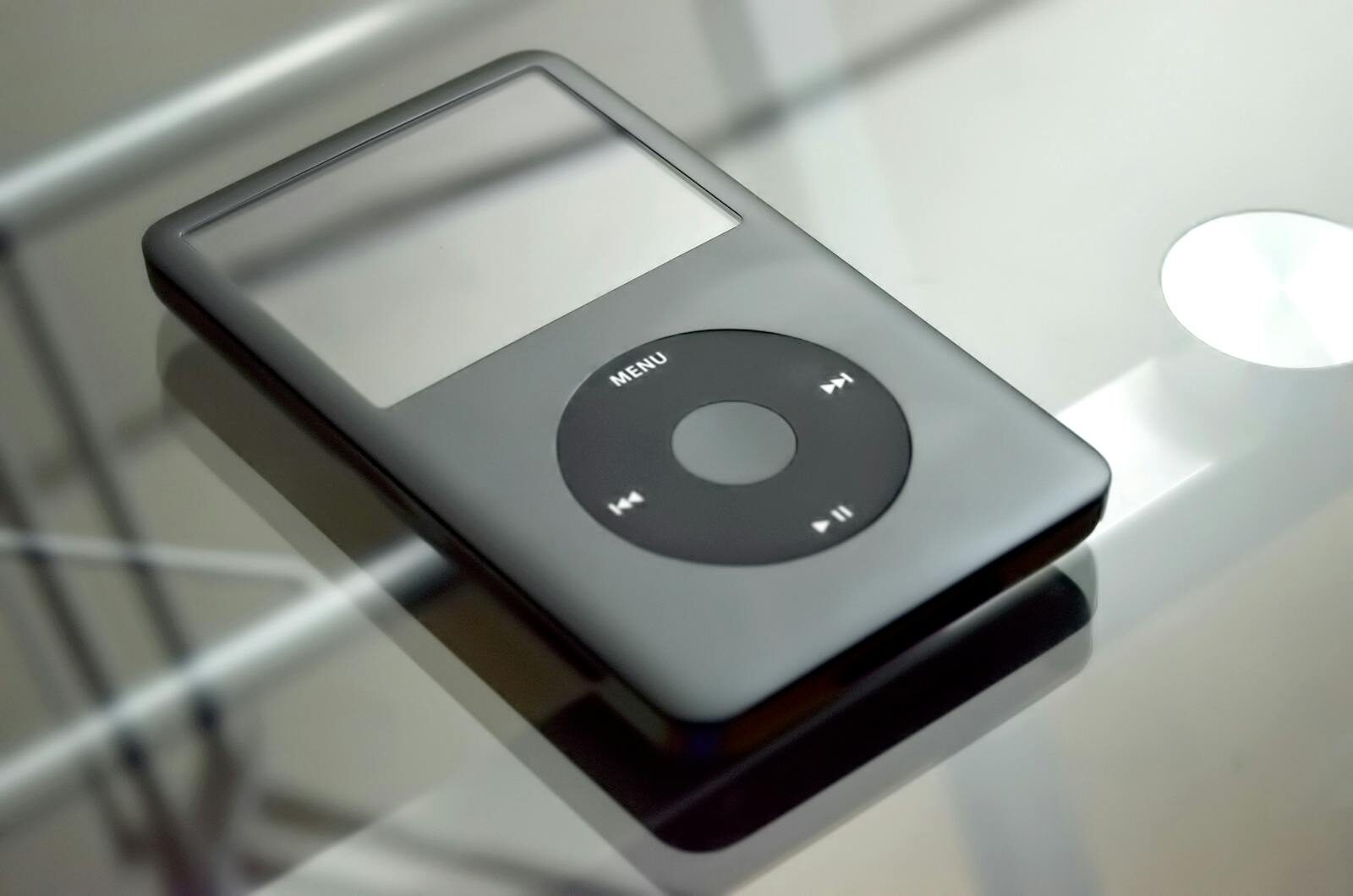
Apple killed its own iPod on May 10, 2022 — a category it had created, sold 450 million units of, and absorbed into another product
The iPod launched on October 23, 2001. Its peak year was Apple’s fiscal 2008, when 54.83 million units shipped, according to Apple’s SEC filings. The line declined every year after the iPhone’s June 2007 launch, then continued limping along for another fifteen years as a Wi-Fi-only consumer device for kids and gym users.
Apple discontinued the entire iPod line on May 10, 2022, after 21 years and an estimated 450 million units sold. The decision was unusual in consumer electronics history: Apple deliberately killed a category-defining product it had invented, dominated, and made roughly $100 billion in revenue from, because its successor product (which Apple also made) had absorbed every function the original served.
The conventional story of corporate self-disruption holds that companies fail to kill their cash cows in time. Apple did kill its cash cow, and did it cleanly. The iPod existed for 21 years, was the most successful music player in history, and now exists only in storage closets and pockets of estate sales.
Motorola dominated a 61-million-user pager market in 1994 — and then ended pager production in 2001 to focus on the phones that were killing them
Pagers — the small belt-clipped devices that beeped when someone wanted you to call them — peaked at over 61 million users globally in 1994. The industry generated about $2 billion annually in revenue, almost all of it controlled by Motorola, which was the dominant manufacturer.
The decline tracks the rise of consumer cellphones almost exactly. By 2008, the global pager-user count had fallen to about 6 million, almost entirely hospital staff, emergency responders, and certain regulated industries that valued pager networks’ simplicity and redundancy. Motorola ended pager production in 2001 — the same company that had defined the category for two decades. The full timeline is captured in GSMArena’s archive of discontinued devices.
The category never fully died. Hospital pagers in the United States still operate over dedicated networks because the protocols are robust against cellular congestion during disasters. But the consumer pager — the symbol of the busy 1990s professional — is gone.
The Palm Pilot was valued higher than General Motors in 2000 — and ceased production in 2011
Palm, Inc. dominated the personal-digital-assistant (PDA) market through the late 1990s and into the early 2000s. The original Palm Pilot 1000 shipped 1 million units in its first 18 months — a consumer-electronics record at the time. By 2000, Palm held about 70% of the global PDA market and was briefly valued by Wall Street higher than General Motors.
The decline began on a specific date: January 9, 2007, when Steve Jobs unveiled the iPhone. By the third quarter of 2007, the iPhone — three months old — was outselling Palm’s Treo line. Palm’s market share fell below 5% by 2010. HP, which had bought Palm in 2010 for $1.2 billion, shut down its hardware operation in 2011. The full company history is preserved in TechSpot’s archive of the Palm Pilot.
What made Palm’s collapse especially fast was that it occurred inside the same product category. Palm wasn’t displaced by a different device serving a different need. It was displaced by a smartphone that did everything the Palm Pilot did and could also make calls, browse the web, and run third-party apps. The decade Palm spent defining the PDA became, retroactively, a decade-long beta test for the smartphone.
Swiss quartz watch exports fell 45% from 2014 to 2022 — and the industry is openly calling it “the next Quartz Crisis”
Swiss watchmakers exported 28.6 million units in 2014. By 2022, that figure had fallen to 15.8 million — a 45% drop in unit volume. The decline began in April 2015, the exact month Apple launched the Apple Watch, and has been steady since.
The Federation of the Swiss Watch Industry has been documenting the trend in its official statistics, and analysts in the trade press have begun explicitly calling it the next Quartz Crisis — a deliberate echo of the 1970s-1980s catastrophe when Japanese quartz movements nearly destroyed Swiss watchmaking. The Federation’s full Swiss watch data shows the asymmetric decline: luxury mechanical watches priced above $1,000 are actually growing in value and unit terms, while the sub-$500 quartz segment — roughly 10.7 million units gone since 2014 — has been hollowed out almost entirely.
The structural pattern is the same as cameras and music players. The smartphone (or the smartwatch it spawned) didn’t kill the high-end of the category; it killed the mass-market middle. Wealthy watch buyers still want mechanical Swiss watches. Casual buyers who used to spend $80 on a Swatch now use the clock on their phone or the Apple Watch on their wrist instead.
Sony ended cassette Walkman production in October 2010 — 31 years after launch, having sold over 400 million units
The Sony Walkman launched in July 1979. By 1989 — a decade later — Sony had sold 100 million units. The cumulative total reached 400 million by 2010. For most of the 1980s, Sony held roughly 50% of the U.S. portable-audio market.
Sony announced the end of cassette Walkman production in October 2010, ending a 31-year production run, on the same year the cumulative sales figure crossed 400 million. The CD Walkman and MiniDisc Walkman had already been displaced by Apple’s iPod (launched 2001). The full retrospective is preserved in CCS Insight’s account of Sony Walkman history.
What’s striking is that Apple — a computer company with no prior music-hardware history — killed the dominant 30-year category leader within five years of entering the market. Sony’s brand survived; it still makes a high-end audiophile “Walkman” today as a niche product. But the universal-product category Sony defined — the portable personal stereo as basic equipment for daily life — was absorbed into iPhones, then into AirPods, then into the streaming services people now play on phones they never put down.
The pattern across all six is that the smartphone didn’t compete with these categories on price, features, or marketing. It absorbed them. The functions persisted; the dedicated products didn’t. A small handful of consumer-electronics companies that defined two decades of mass-market production — Motorola, Palm, Sony, Canon, the entire Swiss quartz industry — found themselves displaced not by better versions of their products but by a different product that included theirs as a free feature. Most of them never recovered.