6 Things AI Is Already Changing in Ordinary Life
The dominant cultural conversation about AI is about future possibilities — replacing knowledge workers, designing drugs, ending democracy or saving it. Meanwhile, most people use machine-learning models hundreds of times a day without noticing. The photograph you took of your dog was constructed by a neural network.
The spam folder you ignored sorted itself with deep learning. The card transaction that did or didn’t go through was risk-scored by an algorithm in under a millisecond. The job you didn’t get an interview for was likely filtered by software before any human read your resume.
AI is already the background infrastructure of everyday life, and the specific numbers behind that infrastructure are more striking than the speculative versions. Six AI applications already running in the seams of daily life, with the named companies and verified statistics behind each.
Your iPhone photo isn’t a photo — it’s a 9-exposure AI composite the phone started shooting before you pressed the shutter
Apple’s “Deep Fusion” computational photography, introduced with the iPhone 11 in September 2019 and integrated across all newer iPhones, processes nine separate exposures into every “single” photo. Four are short exposures, four are secondary, and one is long. Apple’s Neural Engine analyzes approximately 24 million pixels in roughly one second to choose the best result per pixel, fusing detail from each frame into the final image.
The under-discussed part is timing. When you tap the shutter, the phone has already been shooting for several frames — there are buffered exposures stored in memory before you press, which means the “photo” you took includes moments before you decided to take it. Apple SVP Phil Schiller called it “computational photography mad science” at the iPhone 11 launch. The technical details are explained in AppleInsider’s deep dive on Deep Fusion.
Google’s parallel approach, led by Marc Levoy at Google before he left for Adobe, produced Night Sight (2018) — which fuses up to 15 long-exposure frames to produce usable images in near-darkness. The aesthetic style of “smartphone photography” — the saturation, the sharpness, the wide dynamic range that doesn’t exist in nature — is the visual signature of these neural networks making millions of micro-decisions per shot. There is no single “moment” captured. The image is a statistical reconstruction.
Gmail’s AI blocks roughly 15 billion unwanted emails per day at 99.9% accuracy
Gmail’s spam-filtering infrastructure is the largest deployed adversarial machine-learning system in the world. The current public figure from Google is that Gmail blocks approximately 15 billion unwanted emails per day across the service’s user base, at a stated accuracy of 99.9%. A 2024 upgrade to LLM-based filtering reportedly improved spam detection by an additional 20% over the previous TensorFlow-based system.
The structural significance is that spam volume has continued to grow as Gmail’s filtering has gotten better, because spammers train their attacks against the same kinds of models Google deploys. The infrastructure is an ongoing arms race in which both sides retrain constantly. Google’s spam filter documentation explains the architecture.
The user-side experience hides this entirely. Most Gmail users never see their spam folder, never review what was filtered, and never appreciate that without the filter, roughly half of incoming email would be phishing attempts, scams, and marketing junk. The empty inbox is an AI achievement, and it’s also the reason “I didn’t get your email” is now a routine excuse — sometimes the filter is wrong.
Visa’s AI prevented approximately $40 billion in card fraud in a single year — scoring each transaction against 500+ risk attributes in about one millisecond
Visa Advanced Authorization is the company’s real-time fraud-detection system, deployed across roughly 8,000 financial institutions in 129 countries. According to Visa, the system prevented approximately $40 billion in fraudulent transactions between October 2022 and September 2023 — nearly double the previous year’s prevented amount.
The system works by scoring each individual card transaction against more than 500 risk attributes in approximately one millisecond — the time it takes light to travel about 300 kilometers. The features include your typical purchase patterns, the merchant’s risk profile, the geographic context, the time of day, the device used, and dozens of others. Visa has spent more than $3 billion over the last decade building the underlying infrastructure. CNBC’s coverage of the Visa fraud detection system documents the scale.
The result is that global card-fraud rates are now held below 0.1% of transaction volume — a historic low — almost entirely by machine learning, not by human reviewers. The moment your card gets declined at an unfamiliar merchant in an unfamiliar city, it isn’t your bank calling you; it’s a neural network deciding that you don’t usually buy sushi in Tokyo at 2 a.m.
The FDA has now cleared 1,451 AI-enabled medical devices — and 295 of those were cleared in 2025 alone
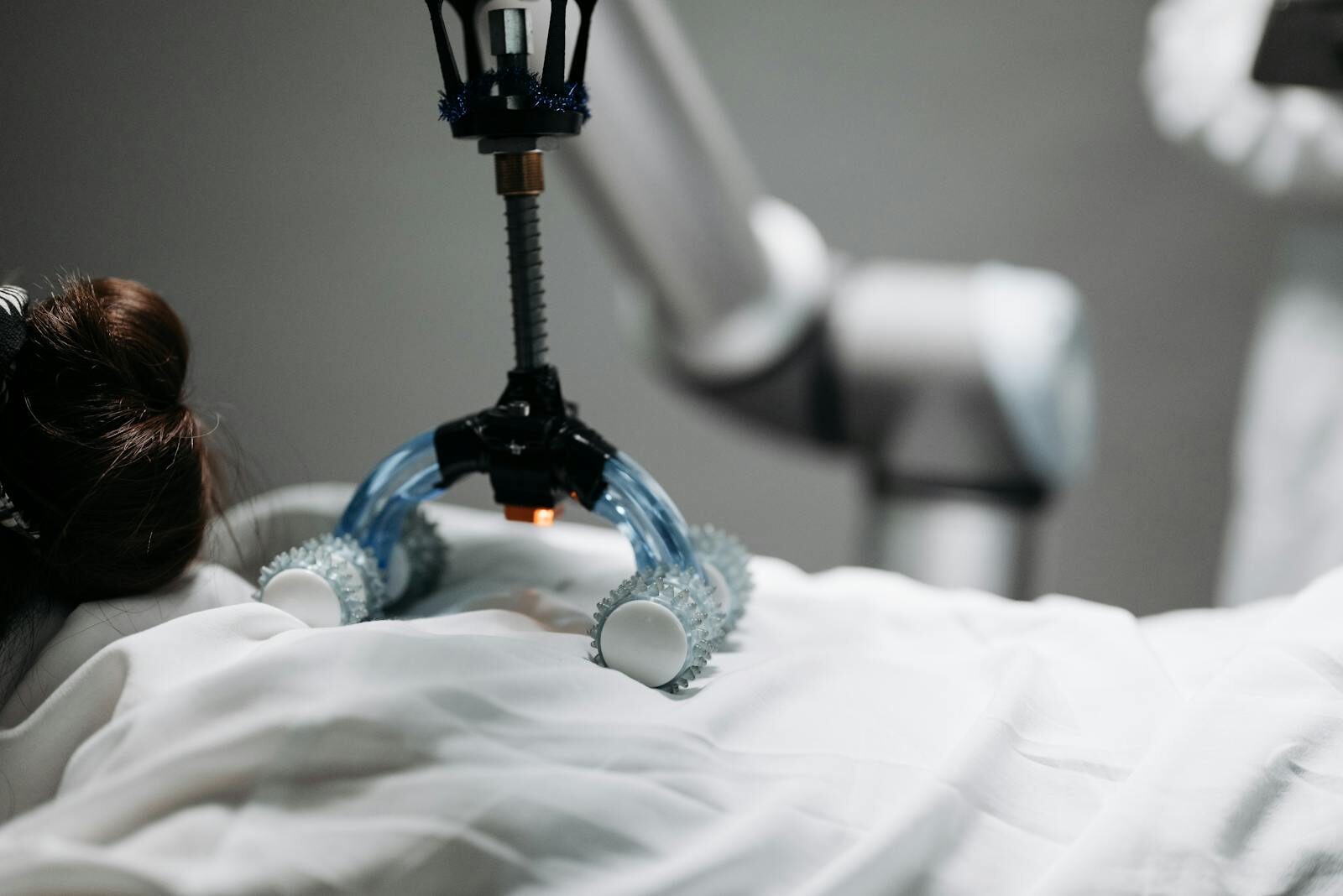
The U.S. Food and Drug Administration maintains a public list of all AI- and machine-learning-enabled medical devices that have received clearance for clinical use. Through 2025, that list has grown to 1,451 devices. In 2025 alone, 295 new AI/ML medical devices received FDA authorization — compared with just 6 in all of 2015. Approximately 76% of cleared devices are in radiology.
The practical consequence is that if you’ve had a mammogram, CT scan, or chest X-ray in the past two years at a major U.S. hospital, an algorithm probably reviewed the image either before or alongside the radiologist. The FDA’s full list of cleared AI medical devices is updated continuously and publicly accessible.
The caveat that medical-device experts emphasize is that most FDA clearances follow the 510(k) pathway, which establishes “substantial equivalence” to an existing predicate device rather than independently validating clinical outcomes. This means many AI tools have entered medical practice without the kind of large-scale prospective trial that pharmaceutical drugs face. The category is moving quickly, the science is still being audited, and the routine claim that “your doctor reviewed it” now often means “an AI triaged it first, your doctor confirmed it.”
99% of Fortune 500 companies use applicant tracking systems — and up to 75% of resumes are filtered out before any human reads them
The applicant tracking system (ATS) is the software layer through which resumes and cover letters pass before reaching a hiring manager. According to industry surveys, 99% of Fortune 500 companies use one of these systems — primarily Workday, SAP SuccessFactors, Oracle Taleo, iCIMS, and Phenom. Roughly 79% of those systems now have AI or automation built directly into them.
The screening function is the consequential part. A 2025 Resume Genius survey found that 48% of hiring managers use AI specifically to screen resumes, and industry estimates suggest up to 75% of submitted resumes are filtered out by software before any human evaluates them. The resume screening ecosystem has become the de facto first stage of essentially every job application at a large company.
The job rejection email a candidate receives saying “we received many qualified applicants” frequently means “your resume scored 62 out of 100 on a keyword-matching model and was auto-rejected before a recruiter opened a queue.” Career advisors now coach applicants on writing resumes for the ATS first and the human second — using specific keyword choices and formatting decisions designed to satisfy the software layer.
Gmail’s Smart Compose feature saves users from typing roughly 2 billion characters per week
Smart Compose — the predictive ghost-text that appears as you type an email in Gmail and lets you accept the suggestion with the Tab key — launched at Google I/O in May 2018. Google’s published post-launch metric is that the feature saves users from typing approximately 2 billion characters per week. The same architecture has been extended to Google Docs, Chat, and Workspace.
The underlying model was documented in Mia Xu Chen and colleagues’ 2019 KDD paper “Gmail Smart Compose: Real-Time Assisted Writing.” The system uses a hybrid LSTM-language model trained on anonymized email data and is engineered to make suggestions in under 100 milliseconds per keystroke. Google Research’s Smart Compose blog post lays out the technical details.
The under-noticed cultural detail is that a non-trivial fraction of the English written in professional email worldwide is statistically suggested by Google before the human types it. The model was specifically retrained to scrub gendered pronouns (“he/she” → neutral suggestions) — meaning Google quietly nudges how hundreds of millions of people write. When you accept the gray ghost-text, you’ve outsourced authorship of that sentence to an autocomplete model trained on prior human writing, and the model’s preferences shape the resulting prose. Whether that’s invisible influence or harmless productivity gain depends on how much you trust the optimization function.
The shared feature across all six is invisibility. None of these AI systems announce themselves to the user. The photograph looks like a photograph, the inbox looks like an inbox, the transaction looks like a transaction, the hospital report looks like a hospital report, the job rejection looks like a job rejection, the email looks like an email. The artificial intelligence is the load-bearing layer underneath the visible interface — and most of the consequential AI in ordinary life works this way. The future-of-AI conversation tends to focus on the dramatic interfaces. The current AI is mostly the invisible scaffolding behind the boring ones.