7 Modern Conveniences People Already Take for Granted
A surprising amount of daily life has been quietly rewired within the last fifteen years. You summon a car from your phone, deposit a check by photographing it, pay for groceries by tapping your wrist, and call a relative in another country while watching them cook dinner, and none of these things existed in any usable form when most of the people doing them were already adults. The cost structures, wait times, and friction points of the world before each of these conveniences arrived are easy to forget. Seven services that have collapsed into background utility within a decade, with the specific numbers attached to each transition.
Free, real-time, turn-by-turn GPS navigation on your phone launched on October 28, 2009 — and erased $1.2 billion of Garmin’s market cap in a single day
Before that date, in-car navigation was a $200 dashboard unit (a Garmin Nuvi or TomTom) with subscription map updates, or an aftermarket OEM system that came installed in luxury vehicles. Standalone GPS units sold for $79 to $499; TomTom’s iPhone app was $50 to $100 at the App Store.
Google Maps Navigation launched October 28, 2009, free, as a default app on Android 2.0 with the Motorola Droid. Garmin shares dropped 16% to $31.60 that day; TomTom dropped 21% to $8.11. The combined market-cap loss exceeded $1.2 billion in 24 hours. Fast Company’s contemporaneous report on the Garmin collapse captured the moment the entire consumer-GPS-hardware category was rendered obsolete by an announcement on a corporate blog.
Apple Maps launched September 2012 with the iPhone 5 (disastrously, then competently). By 2014, paper maps were dead and the standalone-GPS-device industry had effectively collapsed to commercial fleet sales. The friction that disappeared was substantial: pre-2009, “I’ll print directions” was a routine pre-trip activity in most American households.
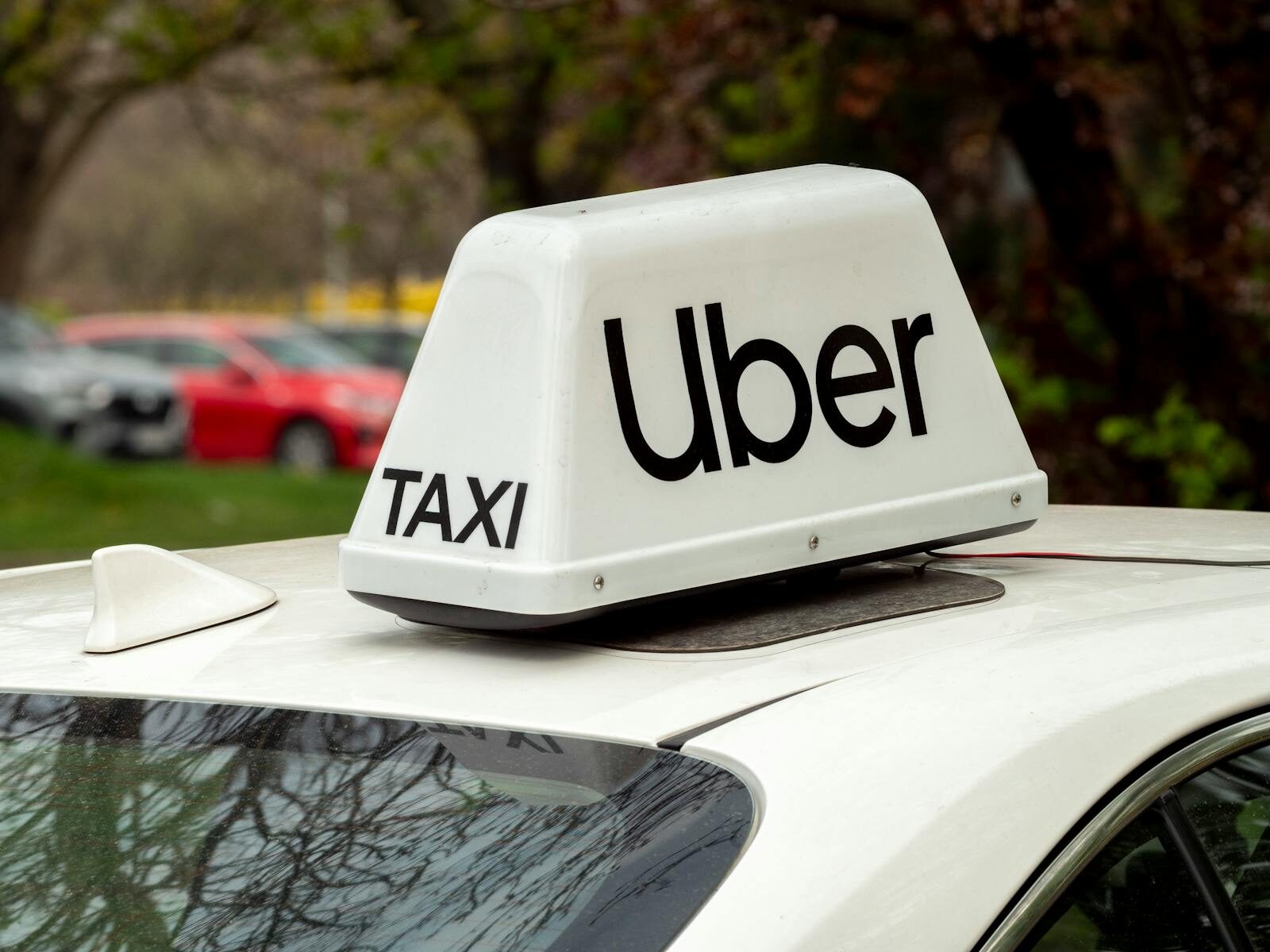
Uber launched in San Francisco in March 2009 — and Princeton economists later found that more than half of pre-Uber taxi miles were empty cruising
The friction Uber removed was specific. Before March 2009, summoning a taxi in most American cities meant calling a dispatcher, providing your address, waiting an indeterminate time (often 30+ minutes), and hoping a cab arrived. In smaller cities, hailing was effectively impossible after dark. Taxi medallion systems capped supply at artificially low levels.
Princeton economists Judd Cramer and Alan Krueger published a 2016 NBER working paper analyzing the supply-side efficiency of ride-share economics. UberX drivers spent roughly 38% more of their time with a paying passenger than traditional taxi drivers. In Los Angeles, only 40% of taxi miles carried a passenger; UberX hit 64%. In Seattle, taxi capacity utilization was 39%; UberX was 55%. Pre-Uber, more than half of every cab’s mileage was empty cruising, paid for by the fares of the riders who did get picked up.
Uber’s 2009 launch (initially named UberCab) coincided with a smartphone-penetration threshold that made the model possible. By 2015, Uber operated in 300 cities globally. The convenience hides a substantial labor-economics story that’s still being argued, but the friction reduction is real and easily quantified.
Apple Pay launched on October 20, 2014 — and at the register, tap-to-pay clears in about three seconds versus eight to ten for an inserted chip card
Contactless payment seems trivial. The transaction-time math, however, is significant at scale. Apple Pay clears in approximately 3 seconds at point of sale; a chip-and-PIN insertion clears in 8 to 10 seconds. Norges Bank’s separate study of European contactless cards found 7.8 seconds for contactless versus 14.8 for insert-and-PIN — roughly half the time.
Apple Pay launched October 20, 2014, with 220 participating retailers and six banks. By 2024, contactless payment was the default at most U.S. retail terminals, with similar systems from Google Pay, Samsung Pay, and bank-issued contactless cards. Apple’s original Apple Pay launch announcement projected the transition.
The compound effect on retail throughput is significant. A grocery checkout that used to take 90 seconds now takes 60. A coffee-shop morning rush that used to back up to the door clears faster. None of it is dramatic, but the cumulative time saved across the U.S. economy each day runs into the millions of hours.
A three-minute phone call from New York to London cost $244.65 in 1930 — and was still $3.32 a minute in 1990
International calling was, within living memory, prohibitively expensive. A 1930 three-minute call from New York to London cost $244.65, adjusted for inflation. In 1990, the same call still ran $3.32 per minute (roughly $7.80 in current dollars), and the AT&T international bill was a routine household budget line for any family with overseas relatives.
The collapse happened in stages. Skype launched August 29, 2003, offering free voice over IP between users. FaceTime launched June 7, 2010, with the iPhone 4. WhatsApp added free voice calls in April 2015 and free video calls shortly after. By 2020, the cost of a one-hour international video call had effectively reached zero on every major platform. The full long distance price collapse is documented in FCC Statistics of Communications Common Carriers historical rate tables.
The reason this convenience is now invisible is precisely that the friction it removed has been gone long enough that most users under 30 have never paid by the minute for a phone call. The world before unlimited free calling was a world of timed conversations, “I’ll call you back when rates drop after 9 PM,” and physical calling cards bought at corner stores.
Mobile check deposit was launched in July 2009 by a small West Virginia credit union — beating USAA’s famous Deposit@Mobile by a month
The standard origin story credits USAA with inventing mobile check deposit, but the actual first U.S. financial institution to launch a smartphone-camera check-deposit app was WV United Federal Credit Union (now Element Federal Credit Union) on July 4, 2009. USAA’s Deposit@Mobile followed in August 2009.
The convenience erased a routine in-person task. Pre-2009, depositing a paper check meant a trip to a branch during business hours, or driving to an ATM. Paper checks remained common for paychecks, rebates, gifts, and small-business payments. Banking journalist Penny Crosman has covered the dispute over mobile deposit origins and the resulting USAA patent settlements with Wells Fargo, PNC, Truist, and Discover.
The technology behind it — image-capture, optical character recognition, automated fraud detection — was non-trivial. The underlying patents have generated tens of millions in licensing fees. From the user’s side, the entire history disappears into “I deposit it with my phone.”
Camera-based real-time translation went free when Google bought Word Lens in May 2014 — and the original app ran entirely offline
Point a phone camera at a sign in another language, and the translated text overlays itself on the original sign in real time, in roughly the original font and color. The technology that enables this was acquired by Google from Quest Visual on May 16, 2014, and integrated into Google Translate on January 14, 2015.
The technically surprising part is that Word Lens did real-time OCR and translation entirely offline on a 2014-era iPhone — no internet connection required. The day Google acquired Quest Visual, all Word Lens language packs (previously $4.99 each) became free. Coverage of the Google Word Lens acquisition captured the moment when international travel suddenly stopped requiring a phrase book.
The friction this removed is hard to overstate. Reading a menu, a street sign, a museum placard, or a medication label in a language you don’t speak used to require a paper dictionary and effort. Now it’s a passive scan with the phone you already had in your hand.
Spotify launched in 2008 — and 2015 was the first year of recorded-music industry growth in fifteen years

The recorded-music industry collapsed almost in half between 1999 (Napster) and 2014, going from approximately $25 billion in global revenue to $14 billion. Industry observers spent 15 years predicting the death of the recording business and arguing about how to reverse the slide.
The reversal happened in 2015, driven entirely by paid streaming subscriptions. Spotify had launched in Sweden, the UK, France, Spain, Finland, and Norway on October 7, 2008, and arrived in the U.S. on July 14, 2011. By 2017, IFPI Global Music Report figures showed paid streaming hit 96% of recorded-music revenue in Sweden, the home of The Pirate Bay. Bismarck Analysis covers the full Spotify history and the supply-side bargain that made it work.
The user-side friction this removed: buying full albums to get one song, ripping CDs, downloading from LimeWire (often with malware attached), choosing which songs to load onto a 4GB iPod for a trip, manually syncing libraries. The new norm — any song, anywhere, with no friction — would have read as fantasy to a 1996 music listener.
The common thread is that each of these conveniences, individually, replaces a friction point most users have now forgotten existed. The cumulative effect on daily life is enormous: a few minutes here, a trip avoided there, a household budget line eliminated, a wait time compressed. The discomfort of the previous world is what’s interesting. None of these inconveniences were noticed when they were standard. They became visible only on the day they disappeared.