7 Modern Habits That Would Confuse People From the Past
If you could time-warp a curious adult from 1985 into a current American kitchen and let them watch a normal Tuesday evening unfold, the explanations they’d ask for would be specific.
Why is everyone photographing their food? Why is your daughter recording a voice note instead of just calling her friend? Why is your husband watching a stranger on his phone explain how to clean a stove? Why does your phone live two feet from your pillow?
Most modern behaviors are old behaviors rerouted through new technology, but a handful of them are genuinely new — and the data on how widely they’re now practiced is more striking than the casual observation of them suggests.
Seven habits that have moved from non-existent to universal inside a single generation, with the prevalence numbers attached to each.
71% of American adults sleep within arm’s reach of their phone — and 23% have fallen asleep holding it
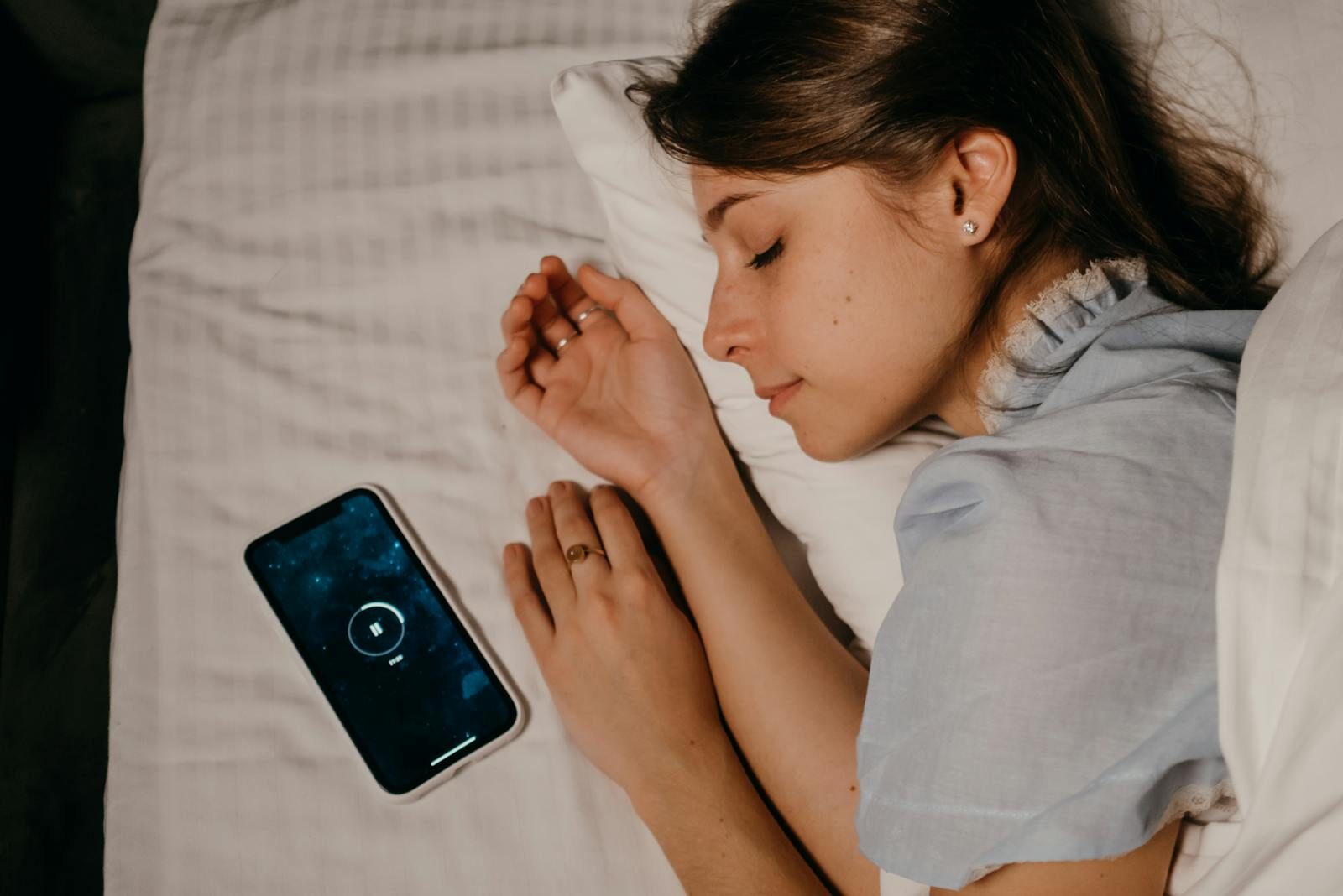
Bank of America’s 2015 Trends in Consumer Mobility Report surveyed a representative sample of U.S. adults and asked where they kept their phones during sleep. Of respondents, 71% slept with the phone within arm’s reach. 23% had fallen asleep holding the device. 34% of 18-to-24-year-olds slept with the phone literally on the bed.
The pre-1990 baseline is worth noting. Home telephones were wired to walls, shared by entire households, and lived in kitchens or hallways. The idea of an electronic communication device sleeping next to you was not technologically possible. The Bank of America mobility report documents the shift in detail.
The behavior has consequences the people doing it usually understate. Nighttime notification checks, ambient blue light, and the cognitive availability of the device all disrupt sleep architecture. The pre-1990 sleeping arrangement, which separated sleep from communication infrastructure entirely, has dissolved within a single generation.
A team of Dutch researchers had to invent a new psychological category in 2014 — “bedtime procrastination” — to describe people staying up scrolling for no reason
Floor Kroese and colleagues at Utrecht University published “Bedtime procrastination: introducing a new area of procrastination” in Frontiers in Psychology in 2014. The paper surveyed 2,431 representative Dutch adults and found that a majority routinely went to bed later than they intended, with no external pressure or unfinished obligation explaining the delay. People were simply choosing, evening after evening, to keep scrolling instead of sleeping.
The phenomenon required a new psychological label because existing procrastination research focused on deferred tasks — things you avoided doing. This was a new category: avoiding the cessation of activity, not avoiding the start of one. The bedtime procrastination study has been replicated multiple times in subsequent samples.
The pre-1990 bedroom contained, at most, a book and a television (which was off, because there was nothing on after midnight). The conditions that produce bedtime procrastination — infinite scrollable content available on a device next to the bed — are technologically specific and historically novel.
“Smombie” — smartphone plus zombie — was Germany’s Youth Word of the Year in 2015, after a 2013 Ohio State study found distracted-walking injuries had doubled in five years
Jack Nasar and Derek Troyer at Ohio State University published a study in Accident Analysis and Prevention in 2013 documenting that emergency-room visits for pedestrian injuries from distracted walking had more than doubled between 2005 and 2010. The researchers extrapolated as many as two million such injuries in 2010 alone, with the highest rates among adults under 30 walking while looking at phones.
The behavior became visible enough that Germany’s Langenscheidt dictionary publishers named “Smombie” — smartphone plus zombie — Youth Word of the Year for 2015. Augsburg responded by embedding traffic-warning lights into the pavement at crosswalks, so pedestrians staring at their phones would see the warning without looking up. Several other cities followed.
The pre-1990 pedestrian carried, at most, a folded newspaper. They could trip on an uneven sidewalk, but they were not, as a default, looking down while walking through traffic. A 1985 adult watching modern pedestrians cross a busy street while scrolling would interpret it as voluntary recklessness rather than routine background behavior.
Forming one-sided emotional relationships with strangers was named “parasocial interaction” in 1956 — long before the technology that now makes it routine
Sociologists Donald Horton and R. Richard Wohl coined the term “parasocial interaction” in a 1956 paper in the journal Psychiatry, describing the way television viewers formed one-sided emotional bonds with TV personalities — news anchors, talk-show hosts, the people who walked into your living room every evening on the screen but didn’t know you existed.
The phenomenon was already real in 1956, but limited by the format. Walter Cronkite read the news for 22 minutes a night, and that was the extent of his presence in any viewer’s daily life. The modern version, enabled by Instagram, TikTok, and YouTube, is qualitatively different. The same viewer can watch a 22-year-old influencer eat breakfast in her bedroom, narrate her drive to work, complain about her boyfriend at lunch, and review skincare products at bedtime — every day, for years. A 2024 Frontiers in Psychology review catalogued 281 peer-reviewed studies on the parasocial interaction phenomenon published in just the five years between 2016 and 2020.
The pre-1990 person did have parasocial relationships, but they had ceilings. A movie star appeared in two films a year; a soap opera ran for an hour a day. The current ceiling is whatever the viewer is willing to consume. A 1985 adult watching someone watch a stranger eat breakfast every morning for six months would assume they were related.
53% of European adults can’t remember their children’s phone numbers — the security company Kaspersky calls it “digital amnesia”
Kaspersky Lab published “The Rise and Impact of Digital Amnesia” in 2015, based on a survey of 6,000 adults across six European countries. The findings: 53% of respondents could not recall their own children’s phone numbers from memory. 51% could not recall their workplace number. 44% — and 63% of smartphone owners — agreed with the statement, “My smartphone is my memory.”
The behavior is rational. Phone numbers are easily retrievable from a contacts app; memorizing them yields no advantage over storing them. But the cognitive offload is total. A pre-1990 adult routinely knew between 15 and 30 phone numbers cold — close family, the workplace, the pizza place, the doctor, several friends — because there was no reliable way to look them up under time pressure. The Kaspersky report on digital amnesia documents the demographic spread of the shift.
What makes the behavior weird to a past observer isn’t the memory loss itself. It’s the universality of the dependency. Lose your phone in 1985 and you could call your mother from a payphone using a memorized number. Lose your phone in 2025 and you are functionally cut off from your own social network until you can sync a backup.
Ghosting — ending a relationship by going silent — required updating the academic taxonomy of breakup tactics, because the 1982 version didn’t include “just disappear”
Tara Collins and Omri Gillath published a 2012 study in the Journal of Research in Personality updating the canonical 1982 inventory of breakup tactics developed by Leslie Baxter. Baxter’s original list — which sociologists had used for thirty years — included strategies like the formal sit-down conversation, the gradual withdrawal, the letter, the proxy message via a mutual friend. It did not include “stop responding to all messages and never explain.”
The behavior was technologically infeasible in 1982. Pre-text-message research subjects could not credibly use silence as a breakup strategy because the social infrastructure didn’t support it — you’d have to actively dodge phone calls, avoid the partner’s neighborhood, and intercept letters. By 2012, vanishing from someone’s life required only turning off your phone notifications. Subsequent surveys among adults 18 to 35 show roughly 65% have ghosted a romantic partner and 72% have been ghosted, per the breakup tactics follow-up literature.
The ghosting category had to be added to the academic taxonomy because the behavior had become statistically common enough that researchers couldn’t measure modern breakups without including it. A pre-1990 adult watching this practice would not understand how anyone could simply not return a call indefinitely, because not returning a call for very long was, in 1985, antisocial behavior with real consequences. In 2025 it’s roughly the median behavior.
The word “selfie” went from non-existent to Oxford Word of the Year in 2013 — a 17,000% rise in usage in 12 months
Oxford Dictionaries named “selfie” Word of the Year for 2013. Their announcement noted that the term’s frequency in English had risen 17,000% over the previous 12 months — the largest single-year usage jump for any candidate word in Oxford’s tracking.
The technology behind the surge was specific. The iPhone 4 launched in June 2010 with the first widely adopted front-facing camera on a smartphone. Pre-2010, taking a photograph of yourself required reversing a camera and guessing the framing, or rigging a tripod and a self-timer. Front-facing cameras made the act effortless. Google estimated in 2014 that roughly 93 million selfies were taken on Android devices alone per day, accounting for about 4% of all photos taken on the platform. The aggregated tracking is summarized in selfie statistics compilations.
The pre-1990 baseline is roughly: you might take one self-portrait per year, intentionally, at a wedding or special occasion, using a self-timer. The current baseline for an active social-media user is closer to several per week. A 1985 adult watching teenagers stop on a sidewalk to angle a phone at their own face for 45 seconds before continuing would interpret it as a small public ritual whose purpose was unclear.
The thread across all seven is that none of these behaviors are exotic to the people doing them. They are routine, even unconscious — the universal habits of waking life for billions of people. But each is technologically specific. Each required something to be invented and then adopted by a large enough majority that the underlying behavior moved from impossible to standard within a generation. The behaviors are not strange. The fact that they’re now standard is.