7 Things Kids Did for Fun Before Screens Took Over
There’s a sound that anyone who grew up before the smartphone era can still summon instantly: the screen door banging shut behind a kid running outside after breakfast, with no particular plan and no expectation of returning until dinner. For most of the 20th century, childhood happened largely outdoors, largely unsupervised, and almost entirely without a screen. The entertainment wasn’t delivered; it was invented, on the spot, out of whatever the neighborhood happened to contain.
This wasn’t a more wholesome era by accident — it was a practical reality shaped by the absence of alternatives. There was nothing to scroll, nothing to stream, and the single television in the house showed cartoons for only a couple of hours on Saturday morning. So children filled the enormous open space of their free time with a remarkable range of self-directed activity. Here are seven of the things they did, and what those activities were quietly building in the process.
Disappearing Outside Until the Streetlights Came On
The defining structure of pre-screen childhood was a simple, unspoken agreement: you went outside, you roamed the neighborhood with other kids, and you came home when the streetlights came on. That was the curfew — not a time, but a signal, visible from anywhere in the neighborhood. Parents often had no precise idea where their children were for hours at a stretch, and this was considered entirely normal rather than negligent.
Within that radius of freedom, kids built a whole social world. They moved in loose packs between yards, sidewalks, vacant lots, and dead-end streets, with the group constantly forming, dissolving, and reforming. There were no phones to coordinate any of it. You found your friends by going to where they were likely to be, knocking on doors, or simply riding your bike around until you spotted someone.
What this produced, beyond the fun of it, was a kind of low-stakes independence that’s become rare. Kids navigated their own conflicts, made their own decisions about where to go and what was safe, and learned to read situations without an adult present to consult. The streetlight curfew handed children a genuine, if bounded, autonomy — and the daily practice of managing themselves within it.
Inventing Games With No Rulebook
A huge portion of pre-screen play consisted of games that came with no instructions, no equipment, and no adult organizing them — games passed down from older kids to younger ones, modified endlessly, and governed by rules that were argued into existence on the spot. Kick the can is the classic example: a hybrid of tag, hide-and-seek, and capture-the-flag, played with nothing but an empty can and whatever territory the neighborhood offered.
The mechanics were elaborate and entirely improvised. One player guarded the can while the others scattered to hide; a hidden player who snuck in and kicked the can could free everyone who’d been caught and sent to “jail.” A single round could sprawl across an entire afternoon and several backyards. The game was a fixture of difficult economic times precisely because it cost nothing — the can was usually something fished out of the trash, sometimes with rocks inside for noise.
Childhood development researchers have a technical name for this category of activity now: unstructured play. The fact that it needed a clinical label at all is a sign of how much it has receded. When kids invent and negotiate their own games, they’re doing real cognitive and social work — setting rules, resolving disputes, balancing fairness against fun, adapting on the fly. There was no referee. The kids were the referees, and learning to be one was part of the point.
Building Forts Out of Whatever Was Lying Around
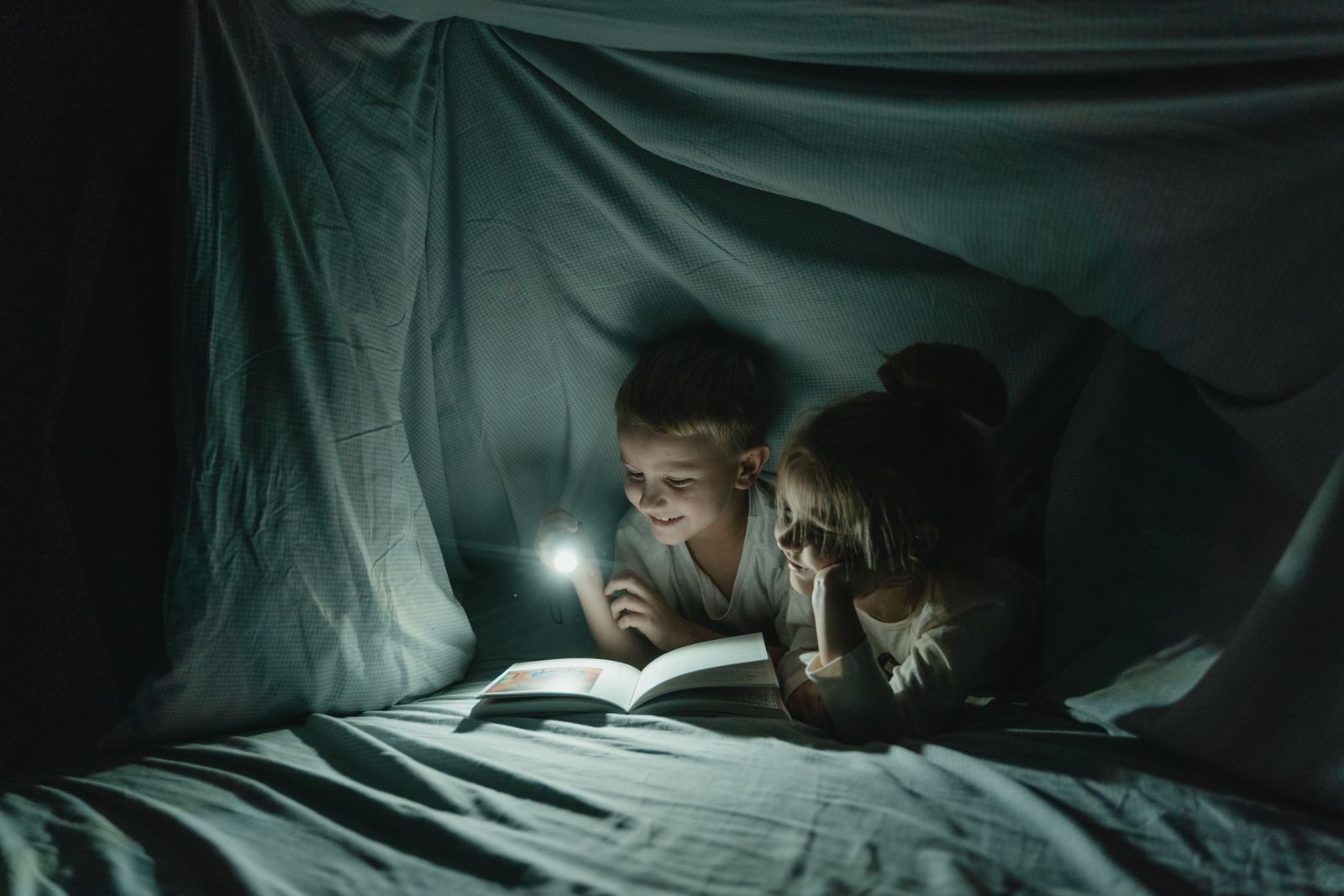
Give a group of kids some blankets, a few chairs, a cardboard box, or a pile of scrap lumber, and they would build a world. Indoor fort-building turned living rooms into castles and caves with draped sheets and dining chairs; outdoors, kids constructed hideouts in trees, in bushes, in drainage ditches, and out of whatever construction-site scraps they could drag together.
The appeal was partly the building and partly the having. A fort was a space that belonged to the kids who made it — a territory outside adult supervision, with its own rules and membership, stocked with comic books and snacks and flashlights. The crawl space under a blanket draped over the kitchen table became, for an afternoon, the most important place in the world.
What made fort-building so durable as an activity is that it combined engineering, imagination, and social organization into one project. Kids had to figure out what would actually hold up a roof of blankets, negotiate who was allowed in, and then sustain an entire imaginary scenario inside the structure they’d built. The materials were free and the result was never the same twice. It was creative construction in the most literal sense, powered entirely by what the kids could scavenge and dream up.
Riding Bikes as Genuine Transportation
For a kid in the pre-screen era, a bicycle wasn’t exercise equipment or a weekend recreation — it was freedom and transportation, the vehicle that extended the radius of the knowable world far beyond what you could reach on foot. The bike was how you got to your friend’s house across the neighborhood, to the corner store for candy, to the creek, to the school playground on a Saturday, to wherever the day was happening.
Kids rode in groups, performed stunts, jumped homemade ramps, and raced through the streets with a casualness toward safety that would alarm a modern parent — helmets were rare to nonexistent for much of this era. The bike was customized and personal, decorated with playing cards clothespinned to the spokes to make a motor sound, and it represented status and capability among the neighborhood kids.
The deeper thing the bike provided was range. A child on a bike could cover miles, make spontaneous decisions about where to go, and return with stories from places the adults in their life never saw. It was self-directed mobility, granted young, and it taught navigation, risk assessment, and the simple confidence that comes from being able to get yourself somewhere and back under your own power.
Reading Stacks of Books, Comics, and Cereal Boxes
In the absence of an infinite content stream, kids who liked to read read voraciously and repeatedly. They tore through library books by the armful, collected and re-collected comic books, and reread their favorites until the spines fell apart. A trip to the library was a major event, and the stack of books you could carry home felt like genuine treasure.
Reading also happened in the cracks of the day, applied to whatever text was available. Kids read the back of the cereal box every single morning, sometimes for weeks, until they had it memorized. They read the comics page of the newspaper, the instructions on board games, the backs of trading cards, the liner notes of records. The hunger for narrative and information found whatever outlet it could.
This kind of deep, repetitive, self-directed reading built vocabulary, attention span, and imagination in ways that are well documented. A child immersed in a book is constructing entire worlds from nothing but text, sustaining concentration across hundreds of pages, and absorbing language patterns that shape their own. The rereading wasn’t a lack of options so much as a way of wringing every drop out of the options you had — and it produced a kind of sustained focus that’s measurably harder to come by now.
Trading and Collecting Physical Things

Before everything became digital, kids built elaborate economies around physical objects: baseball cards, marbles, stickers, comic books, stamps, coins, and whatever else could be acquired, sorted, displayed, and traded. These collections were serious business, governed by intricate informal systems of value and negotiation.
Marbles were both a game and a currency — kids competed to knock each other’s marbles out of a circle, and a rare or beautiful marble carried real status. Baseball cards were studied, protected, sorted, and swapped through hard-nosed negotiations where a kid had to know exactly what each card was worth and drive a fair bargain. Even snacks became tradeable goods, with lunchbox contents bartered through daily cafeteria diplomacy.
The collecting and trading taught a surprising amount: categorization, valuation, negotiation, patience, and the social skills required to strike a deal that both sides walked away from satisfied. A kid managing a baseball card collection was running a tiny, self-taught course in economics and human nature. The objects were physical, finite, and personally owned, which gave the whole enterprise a weight that’s hard to replicate when collections live as pixels in an app.
Being Bored — and Then Doing Something About It
Perhaps the strangest thing about pre-screen childhood, from a modern vantage, is how much of it was spent doing nothing in particular. Long, shapeless stretches of boredom were a normal feature of growing up. There was no device to reach for the instant a dull moment arrived, which meant kids regularly bumped up against the blank wall of having nothing to do.
And then, reliably, something happened on the other side of that boredom. The empty afternoon that started with a kid lying on the floor complaining there was nothing to do would, an hour later, have produced an invented game, a backyard expedition, a half-built contraption, a drawing, a plan. Boredom was the raw material that imagination acted on. With no external entertainment available, the mind eventually turned inward and generated its own.
This may be the quietest but most significant casualty of the screen era. The capacity to tolerate boredom — and the creativity that boredom forces into existence — used to be developed by the simple, daily fact of having nothing to do and no way to make it stop except from the inside. Kids learned that they were the source of their own entertainment, that an empty afternoon was a problem they themselves could solve. The screen removed the boredom, and with it removed the daily exercise of inventing a way out. It turns out the empty hours were doing something important all along.
None of this is to say the past was better in every way, or that there’s no value in what screens offer children now. But it’s worth recognizing what these old activities had in common: they were self-directed, they were largely unsupervised, and they handed children the job of filling their own time. In doing that job, day after day, kids built independence, creativity, social skill, and the deep-seated confidence that they could make their own fun out of almost nothing. That was never the point, as far as the kids were concerned. They were just playing. But the playing was building the people they’d become.