5 Vintage Items That Show How Much Daily Life Has Changed
Objects carry the fingerprints of the lives that used them. You can learn more about how people actually lived in 1965 from the things that sat on their kitchen counters and end tables than from almost any history book — because those things were shaped, down to the smallest detail, by constraints we no longer even think about. The single phone tethered to the wall, the bookshelf that doubled as the family’s entire reference library, the camera that made you wait two weeks to find out if the photo came out: each of these was a sensible answer to a problem that technology has since erased so completely that the object now looks faintly absurd.
Here are five vintage items that, looked at closely, reveal just how radically the texture of ordinary life has shifted in a single lifetime.
The Rotary Phone on a Party Line
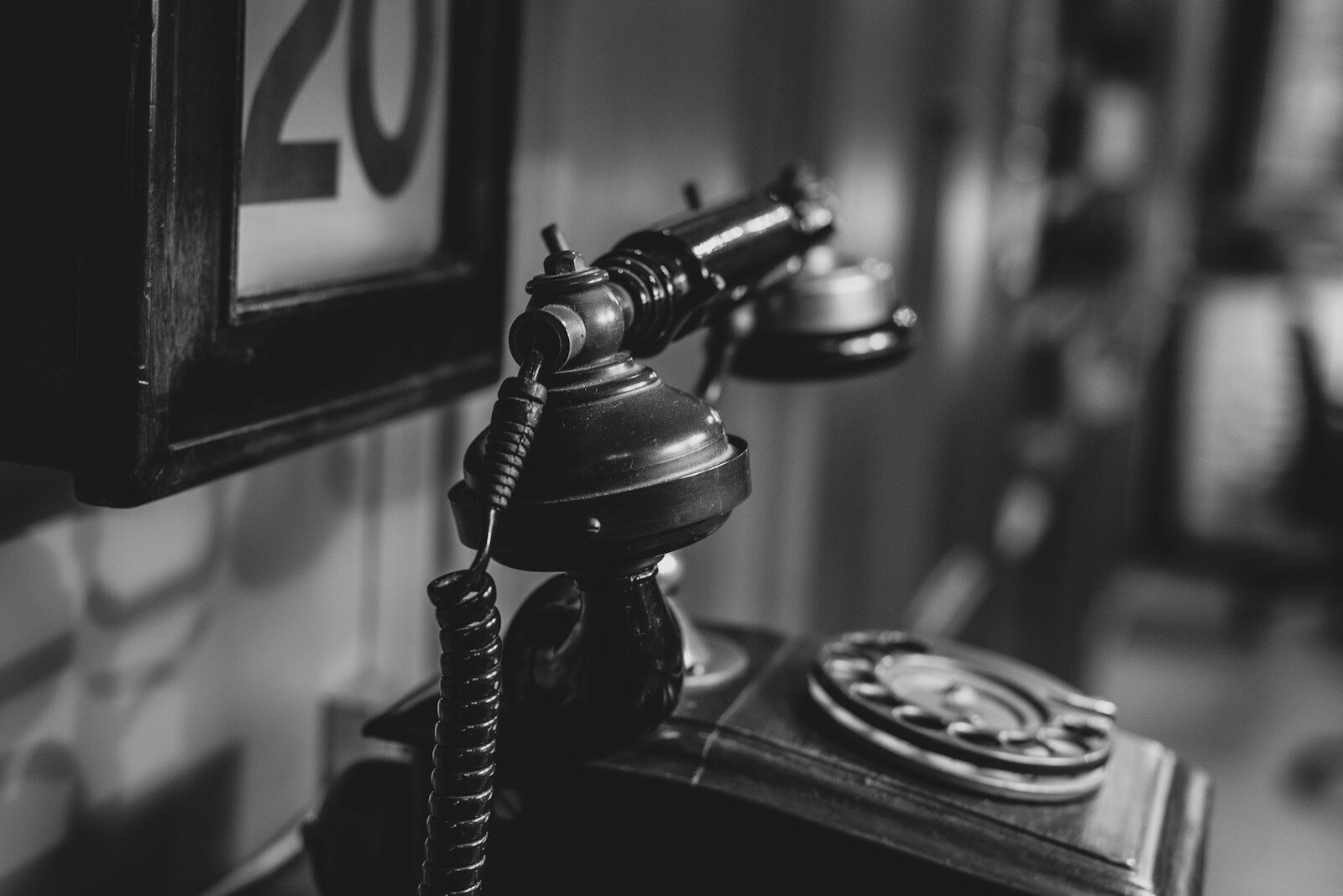
The household telephone of the mid-20th century was a heavy, corded instrument, usually mounted on the kitchen wall or sitting on a hallway table, and dialing it was a deliberate physical act. You put your finger in the hole over the right number, pulled the dial clockwise to the metal stopper, and let it spin back before dialing the next digit. A single wrong number near the end meant starting the whole sequence over. There was one phone, in one place, and everyone in the family shared it.
What’s stranger to modern eyes is that, for millions of households, they didn’t even have the line to themselves. A majority of Bell System subscribers in the mid-20th century were served by “party lines” — a single telephone circuit shared among several different households, offered at a discount over a private line. If you picked up the receiver to make a call and heard your neighbors already talking, you hung up and tried again later. Incoming calls were distinguished by ring patterns: a specific sequence of short and long rings told you whether the call was for your house or for someone else on the line.
The arrangement offered no privacy whatsoever, and party lines became famous as engines of small-town gossip — anyone could quietly lift the receiver and listen in. They also doubled as an emergency broadcast system, since one person could alert several households at once to a fire or a crisis. The last operating party line in the United States, in Woodbury, Connecticut, didn’t shut down until 1991. Set that beside the smartphone in your pocket — a private, instantaneous, global communication device that also happens to be a camera, a map, and a library — and the distance traveled in a single generation becomes hard to fully absorb.
The Family Encyclopedia Set
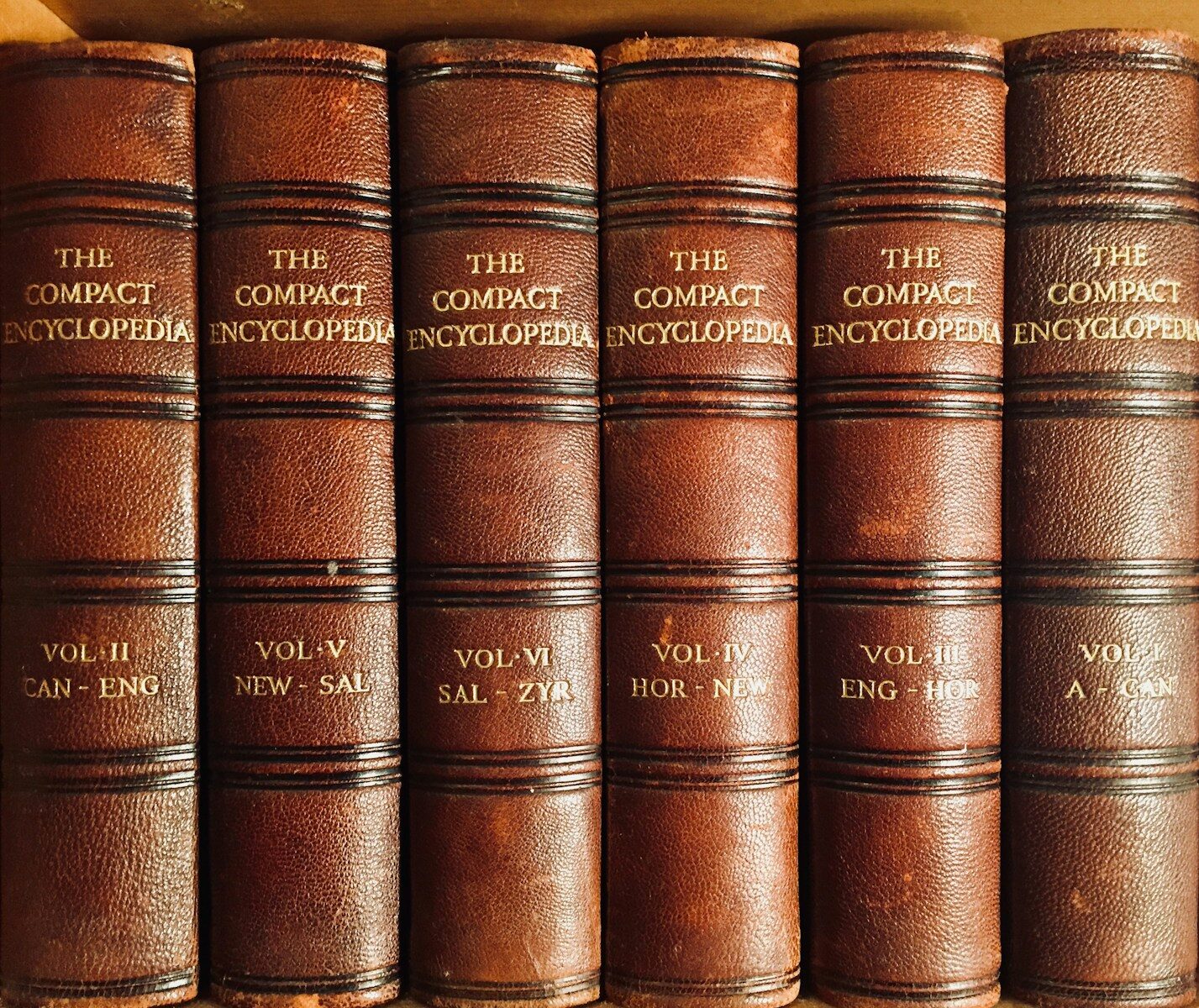
For much of the 20th century, the mark of a serious household was a shelf of matching encyclopedia volumes — twenty or more thick, gilt-lettered books that represented the family’s entire on-demand store of factual knowledge about the world. If a child had a question about the Amazon River, the Roman Empire, or how a combustion engine worked, the answer was found by pulling the right alphabetized volume off the shelf and looking it up.
These sets were expensive, and they were typically sold door-to-door by traveling salesmen on monthly installment plans. In 1932, a Sears executive named Elkan Harrison Powell took over Encyclopaedia Britannica and introduced both door-to-door installment sales and a policy of continuous revision, so families could buy updated sets and annual yearbooks to keep current. Owning a full set became a status symbol on the order of a car or a television — a visible declaration that this was a household that valued education and could afford to prove it.
The deepest change the encyclopedia reveals isn’t about books; it’s about the relationship between people and information. A printed encyclopedia was authoritative, curated, finite, and immediately out of date — the set bought in 1965 still said, decades later, whatever it had said in 1965. Updating your knowledge meant buying the yearbook or, eventually, the whole set again. The idea that any person could hold a device that instantly searches a constantly updated store of nearly all human knowledge would have seemed less like a product and more like magic. The encyclopedia was the best available answer to a real hunger for information. We answered that hunger so thoroughly that the books became furniture.
The Television With Rabbit Ears and No Remote
The television set of the 1960s and ’70s was a heavy piece of furniture, and operating it was a hands-on affair. To change the channel, you got up, walked to the set, and turned a physical dial that clunked through the positions. Most sets had two dials — one for the VHF channels and a separate one for UHF — and with only a handful of stations available, “channel surfing” wasn’t really a concept. There was no remote control in the average home for decades. The remote was a person, usually the youngest child, dispatched across the room on command.
Reception was its own ongoing project. Indoor sets relied on a pair of adjustable telescoping antennas — universally nicknamed “rabbit ears” — that had to be physically positioned, angled, and extended to pull a watchable signal out of the air. Rabbit ears worked by capturing over-the-air VHF broadcast signals, and getting a clear picture often meant standing in a particular spot, draping foil over the tips, or holding the antenna at exactly the right angle while someone else confirmed the picture had cleared. A passing truck or a bad weather front could turn the screen to snow.
The television that demanded all this fuss tells you how much of daily life used to be governed by physical fiddling and patience. You couldn’t pause it, record it on a whim, rewind a missed line, or watch anything other than what was being broadcast at that exact moment. The set anchored the household to a schedule and a spot in the room. The flat, silent, instantly responsive screens we now carry and mount everywhere are not just better televisions — they represent the disappearance of an entire category of small daily labor.
The Road Atlas and the Glove-Box Map
Before a calm voice in the dashboard told you exactly where to turn, finding your way to an unfamiliar place depended on paper. Every car had maps in the glove box — folded road maps, often given away free at gas stations, and for longer trips, a bound road atlas covering an entire state or country. Planning a drive meant spreading the map out in advance, locating your start and destination, and tracing the route by hand, sometimes writing the turns on a separate scrap of paper to consult while driving.
The paper map demanded a set of skills that have quietly become optional. You had to orient yourself, understand the scale, translate the flat grid into the real roads passing by your window, and constantly track where you were against where you’d planned to be. When the route failed — a closed road, a missed exit, a town that wasn’t where you thought — you pulled over and asked a stranger, or stopped at a gas station, where the attendant would point you the right way. Refolding the map correctly was a notorious minor ordeal of its own.
What the glove-box map reveals is a completely different relationship with place and certainty. Getting lost was a normal, expected part of travel, and people built extra time into trips to account for it. The reward was that travelers carried genuine mental maps of their regions, knew landmarks and shortcuts by heart, and could navigate from memory. The glowing blue dot that now shows your exact position at all times solved the problem of getting lost so completely that an entire form of everyday competence — simply knowing where you are — has become something most people no longer need to practice.
The Film Camera
The camera of the pre-digital era ran on rolls of film, and every aspect of how people took pictures was shaped by that fact. A roll held a fixed, small number of exposures — commonly 24 or 36 frames — and once you’d used them, that was it until you bought and loaded another roll. Every press of the shutter cost money, both for the film and for the developing, which meant every photograph was a small economic decision.
And you couldn’t see the result. You shot the entire roll blind, dropped it off at a pharmacy or a camera shop or mailed it away, and then waited — often a week or more — to find out what you’d actually captured. By the mid-1990s, a 36-exposure roll plus basic processing cost well over ten dollars, and one-hour photo counters were considered a luxury convenience. When the envelope of prints finally came back, it always contained failures: shots ruined by a thumb over the lens, a blink, a shake, bad light. You paid to develop those too. Some rolls sat half-finished in cameras for months, even years, before anyone bothered to shoot the last few frames and find out what was on them.
This scarcity shaped behavior in ways that are almost the exact inverse of how we photograph now. People took fewer pictures and chose their moments carefully, because every frame counted and none could be reviewed or deleted. A photograph was a genuine commitment of money and a gamble on the result. Today the typical person carries a camera that takes effectively unlimited, instantly reviewable, free photographs, and the average phone holds thousands of them. The film camera reveals how completely abundance has replaced scarcity in one of the most universal human activities — capturing a moment — and how that shift has changed not just how many pictures we take, but how much any single one of them feels like it’s worth.
What links these five objects is that none of them was primitive in its own time. Each was a thoughtful, well-made solution to a genuine problem, and each defined the rhythm of ordinary life for the people who relied on it. They didn’t disappear because they were bad. They disappeared because the constraints that gave them their shape — the cost of a phone line, the difficulty of distributing knowledge, the scarcity of film — were dissolved, one by one, by technology. Looking at them now is a way of measuring exactly how far, and how fast, the ground beneath daily life has moved.