7 Things From Grandma’s House Younger People Don’t Recognize
The interior of a 1960s American living room contained roughly fifteen objects whose function would now require explanation. The lace cloth on the back of the chair, the rotating wheel of phone numbers, the cardboard box of slides next to the projector, the percolator burbling on the stove — these weren’t quirky design choices. They were the dominant solutions to specific everyday problems, and most of them have been replaced inside a single generation. Most of them also have surprisingly specific origin stories: a named inventor, a patent date, and an unrelated technology that killed them on a known year. Seven of them, with the actual histories.
The lace cloth on the back of the armchair was called an antimacassar — named after the hair oil it was designed to repel
If you ever wondered why mid-century furniture had decorative cloth panels draped over the backs of chairs and sofas, the answer is Victorian-era men’s hair grease.
Rowland’s Macassar Oil — a heavily marketed pomade launched around 1793 by London barber Alexander Rowland — was made from ingredients supposedly sourced through the Indonesian port of Makassar. The oil dominated men’s grooming for most of the 19th century and was one of the first nationally advertised products in Britain. The oil also ruined upholstery, leaving permanent grease stains wherever a man rested his head.
By around 1850, the protective cloth that hostesses placed over chair backs had acquired its proper name: the antimacassar — literally, “against Macassar.” The defensive purpose became unnecessary in 1928 when Brylcreem launched, replacing greasy hair pomades with water-based products. The cloths lingered for another sixty years as pure decoration, then mostly disappeared.
The rotating wheel of business cards on every office desk was called a Rolodex — and was invented by a Danish engineer in 1956

Arnold Neustadter built a small empire in New York selling rotating office gadgets through his company Zephyr American — the Autodex address-book, the Swivodex spill-proof inkwell, the Punchodex hole punch. In 1956 his Danish chief engineer, Hildaur Neilsen, designed the device that gave them their lasting fame: a rotating wheel of removable index cards, each holding one contact’s information.
It launched commercially in 1958 as the Rolodex and dominated American business culture for the next four decades. At its peak, every executive desk in the country had one, and the device became a proxy for professional power — “his Rolodex” meant the entire network of contacts a person could call. The Smithsonian holds an original example in its Rolodex collection.
The smartphone killed the device but not the metaphor. The word “Rolodex” still appears regularly in business writing, used as a verb and a noun by people who have never touched one of the actual machines. Few business objects have outlived their physical form so durably in language.
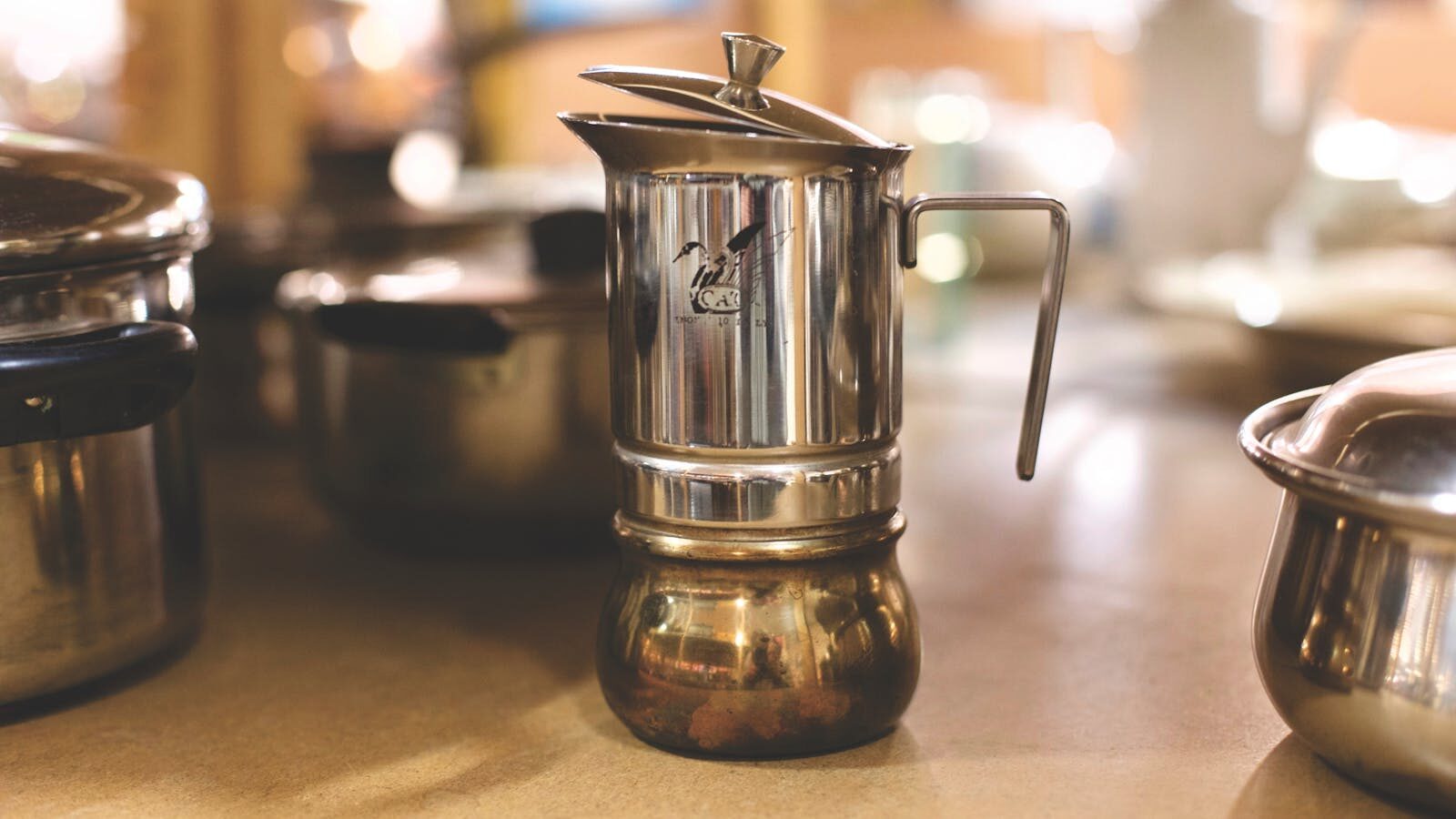
The percolator coffee pot dominated American kitchens for a century — and was killed inside one decade by a single 1972 launch
The percolator’s first U.S. patent (number 51,741) was issued December 26, 1865, to James H. Nason of Franklin, Massachusetts. By the 1920s, the chrome stovetop or electric percolator with the glass-knob lid was the default American coffee maker, and it stayed that way for fifty years.
Then on December 28, 1972, the Mr. Coffee automatic drip machine — invented by Vincent Marotta and Samuel Glazer in Cleveland — went on sale. The drip-brew system used a paper filter and gravity, eliminating the percolator’s tendency to over-extract bitter coffee by repeatedly recirculating boiling water through the grounds. Marotta hired Joe DiMaggio as the on-camera Mr. Coffee pitchman in 1973.
The reception was overwhelming. By 1975, over 1 million units had sold. By Christmas 1977, department stores were moving 40,000 Mr. Coffee machines a day. Within a decade, the percolator — a fixture of American mornings since the post-Civil War era — had been almost entirely displaced. It survives now mostly as a camping appliance and a nostalgia object.
The Kodak Carousel slide projector — made in 87 different models over 43 years — was discontinued in October 2004
Before digital photos, the standard way to share family pictures was to invite friends over, dim the lights, and operate a rotating tray of 35mm slides through a Kodak Carousel projector. The format launched in spring 1962. The rotating tray that gave the product its name was invented by Louis Misuraca, a Naples-born immigrant who reportedly sold the patent to Kodak for a modest sum.
Across 43 years of production, Kodak built 87 different Carousel models. The peak years were the late 1960s and 1970s, when slide film was the dominant medium for family photography and the slide show was a routine evening’s entertainment. The Kodak Carousel became cultural shorthand for the suburban living room.
The most famous depiction is fictional — Don Draper’s “it’s not a spaceship, it’s a time machine” pitch in the Mad Men episode “The Wheel” (2007). The pitch is invented, but Kodak’s actual Carousel marketing through the 1960s leaned hard on nostalgia and family-memory positioning. Kodak ended production in October 2004 as digital displaced slide film entirely. The projectors still work; almost no one uses them.
The folding TV tray emerged from a 1953 marketing emergency — Swanson had 260 tons of unsold Thanksgiving turkey
In 1953, the C.A. Swanson & Sons frozen-food company was stuck with 260 tons of unsold Thanksgiving turkey sitting in ten refrigerated railcars and no way to move them. A company salesman named Gerry Thomas — who had been inspired by airline meal trays during his military service — proposed packaging the turkey with stuffing, gravy, peas, and sweet potatoes in a compartmentalized aluminum tray. He was paid a $1,000 bonus for the idea.
The Swanson TV Dinner launched later that year. Swanson sold 10 million dinners in 1954, the first full year of national distribution. The aluminum-tray product needed a place to eat it, and within a few years the folding metal-and-faux-wood TV tray table — usually sold in sets of four with a rack — became standard household furniture. Smithsonian Magazine’s history of the TV Dinner covers the full origin.
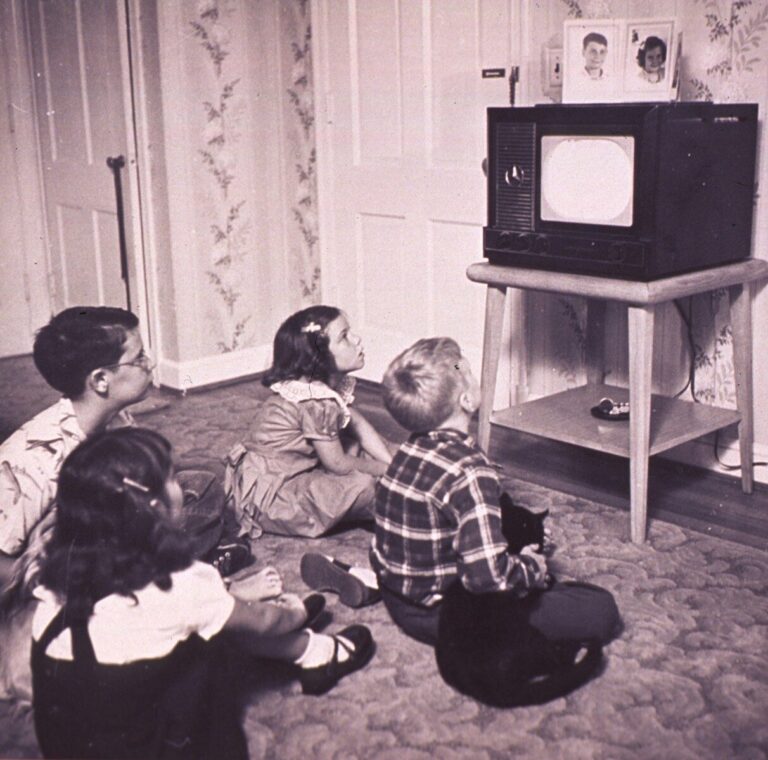
What killed the dedicated TV tray was open-plan kitchens, kitchen islands large enough to eat at, and the cultural shift toward eating while standing or scrolling. The folding trays still exist, but the ritual they served — the family arranged in front of the console TV with individual trays — vanished with the rooms it depended on.
The wobbling tower of suspended fruit, mayo, and meat in a Jell-O mold was a 1950s refrigerator status symbol
Powdered gelatin was commercialized in the 1840s by tanners looking to monetize an animal byproduct. The dish that defined the savory-gelatin era — Perfection Salad — emerged from Knox Gelatine’s 1905 recipe contest, and the form became standard middle-class American cuisine for the next sixty years.
The 1950s peak of the molded-aspic dish wasn’t really about flavor. It was a refrigerator status symbol. Home refrigeration was still expensive enough that gelatin desserts — which required hours of chilling at consistent temperature — functioned as a flex. A multi-layered Jell-O tower studded with olives, hard-boiled eggs, or hot-dog slices essentially announced: we own a working refrigerator, and we use it dramatically.
Julia Child’s Mastering the Art of French Cooking (1961) and her PBS series (debuting 1963) catalyzed the food-culture shift away from convenience-era cooking. Cheaper refrigeration removed the status signal. By the 1970s, savory aspic was an embarrassment, surviving only at church potlucks and in cookbooks of historical curiosity. The molds themselves now sell mostly as decorative kitchen art.
The household ashtray in every room reflected an era when 42% of American adults smoked — until a January 1964 government report changed the trajectory
The smoking ashtray on the side table — usually heavy crystal or ceramic, often a souvenir or a hostess gift — was a near-universal household object for most of the 20th century. By the early 1960s, 42% of American adults smoked. Even nonsmoking households kept “guest ashtrays” out of social courtesy. Restaurants, airplanes, hospitals, and offices all assumed smoking by default.
The turn began on January 11, 1964, when Surgeon General Luther L. Terry, M.D., released a 386-page report definitively linking cigarettes to lung cancer and other diseases. The Harvard Health summary of the Surgeon General’s report notes that smoking rates fell from 42% in 1964 to roughly 18% today, an aggregate decline that JAMA has estimated prevented around 8 million premature deaths.
Indoor smoking bans, starting with California’s restaurant ban in 1995 and accelerating through the 2000s, finished the cultural shift. The household ashtray became, first, a guest ashtray; then a decorative bowl; then nothing. A 1955 home walkthrough would have produced one in nearly every room. A 2025 home walkthrough produces zero in most.
None of these objects went anywhere because of changing taste alone. Each was displaced by something specific: water-based hair gel, the smartphone, an automatic drip coffeemaker, digital photography, the open-plan kitchen, Julia Child, the Surgeon General. The contents of a 1965 living room weren’t whimsical period decoration. They were the right answers to questions that have since been answered differently.