5 Forgotten Household Tools That Were More Useful Than They Looked
Walk through any antique store and you’ll find a back shelf full of objects nobody can quite identify anymore. A crank attached to a gear. A heavy iron device with a wheel and a belt. A wooden cabinet with a strange compartment up top. These were not decorations and they were not novelties. They were the workhorses of a household that had no electricity to lean on, and many of them solved their particular problem so well that the only reason they disappeared was that something plugged into a wall did the same job while you went and did something else.
It’s easy to look at these tools as quaint — the charming, inefficient gadgets of a slower age. That view gets the story backward. Most of them were marvels of mechanical design, engineered to extract the maximum amount of work from the minimum amount of human effort, using nothing but gears, leverage, and the occasional well-placed block of ice. Here are five that were far more capable than they appear, and the clever thinking built into each one.
The Hand-Crank Eggbeater
Before the stand mixer, before the immersion blender, before anything that hummed, there was the rotary eggbeater: a tool you held in one hand and cranked with the other, spinning two interlocking whisks through whatever was in the bowl. It looks almost comically simple. It was, in fact, a precisely engineered piece of gearing that delivered a mechanical advantage most people never stopped to appreciate.
The principle is the same one that makes a bicycle work. The hand-crank eggbeater was a fixture in virtually every American kitchen for the better part of a century. A single turn of the large crank gear translated into many rotations of the small gears driving the beaters. One comfortable revolution of your hand became four or five fast rotations of the whisks. This is a gear ratio doing exactly what gear ratios are designed to do — trading the distance your hand travels for speed at the business end. The cook supplied slow, easy effort; the tool converted it into fast, vigorous beating.
The design was so effective that hand-crank beaters whipped cream and beat egg whites to stiff peaks faster than many people manage with a wire whisk today, and with a fraction of the wrist fatigue. They required no power, never needed charging, cost almost nothing to maintain, and lasted for generations. Many of the ones sitting in antique stores still spin smoothly. The electric mixer didn’t beat them on performance for small jobs. It beat them by letting you walk away.
The Carpet Sweeper
The carpet sweeper is one of the great examples of elegant engineering hiding inside a humble object. Patented by Melville Bissell in 1876, it is, at its core, a box on wheels with a brush cylinder inside and absolutely no motor. Push it across the floor, and the friction of the wheels turns the brush, which flicks dirt and crumbs up into an internal pan. Stop pushing, and it stops. There is nothing to plug in, nothing to charge, and nothing to make noise.
What makes the design clever is how it harnesses the energy you’re already spending. The act of pushing the sweeper forward is the same act that powers it — the human provides locomotion, and the machine quietly siphons off a fraction of that motion to spin the brushes. There is no wasted step. The whole device is a study in doing more with less, capturing energy that would otherwise be lost to the floor and redirecting it into cleaning.
This is exactly why carpet sweepers never fully went away. They remain in use in restaurants, hotels, and other settings where someone needs to quietly clear a small mess without dragging out a vacuum, waking a sleeping baby, or disturbing diners. They’re light, they’re silent, they need no electricity, and for crumbs under a table they’re often faster than the powered alternative. A tool designed in the 1870s still earns its keep because the underlying engineering was simply sound.
The Treadle Sewing Machine
The treadle sewing machine is the one that most often stops people in antique stores, usually because the cast-iron base is beautiful and nobody can figure out how it ran. The answer is at the bottom: a wide, flat pedal that the operator rocked back and forth with both feet. That rocking motion turned a large wheel, a belt carried the motion up to the machine head, and the needle flew.
Isaac Singer patented his treadle sewing machine in the early 1850s, and the design dominated home sewing for roughly a century, with machines manufactured well into the 1950s. The genius of the treadle was what it freed up. A hand-crank machine demanded one hand to operate, leaving only the other to manage the fabric. The treadle moved the power source down to the feet, which had nothing else to do, and gave the sewer both hands to guide the material. The result was faster, more precise sewing with far better control.
There’s a reason these machines are still sought out and used today. In parts of the world where electricity is unreliable, treadle machines remain in everyday service, and even where power is abundant, some sewers prefer them for the fine, slow control the foot pedal allows — you can sew a single stitch at a time, with a precision that’s hard to match on a motorized machine. The treadle didn’t lose on capability. It lost on convenience, and only barely.
The Icebox
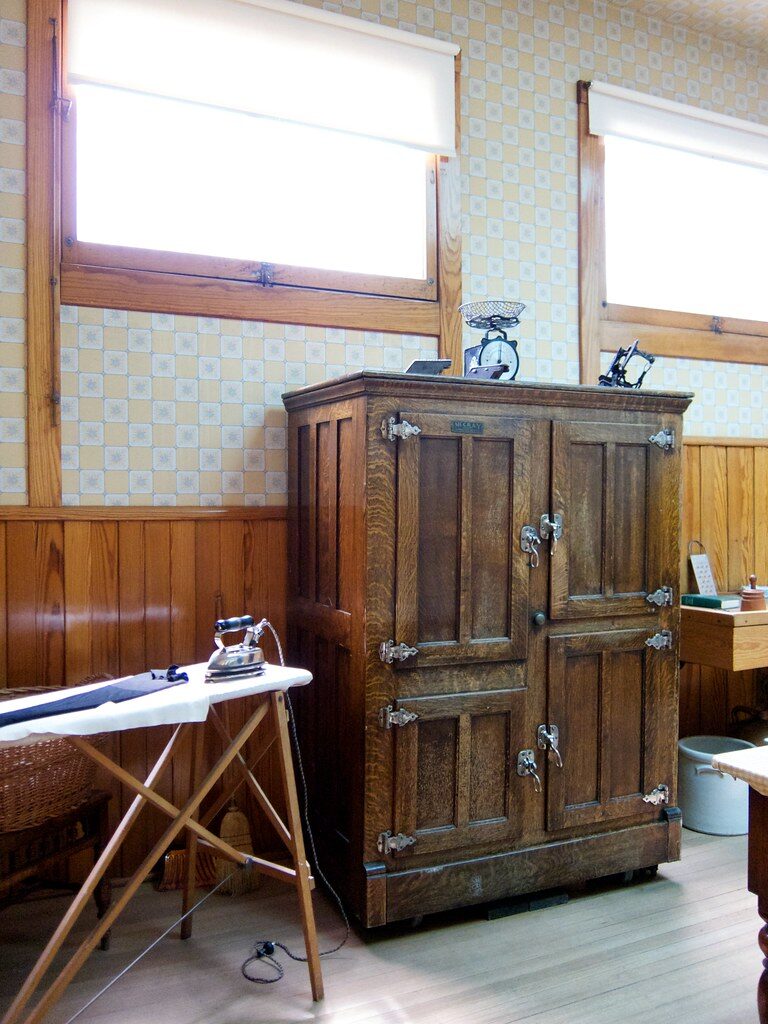
Before the refrigerator earned its nickname, the “icebox” was a literal box that held ice. And while it sounds primitive — a wooden cabinet with a block of frozen water inside — the engineering of a good icebox was considerably more thoughtful than it first appears.
An icebox was an insulated wooden cabinet, typically lined with tin or zinc and packed with sawdust, cork, or even seaweed for insulation. A large block of ice sat in a compartment at the top, and here is the clever part: it was placed at the top on purpose. Cold air sinks. As the ice chilled the air around it, that cold air fell down through the food compartments below, while warmer air rose back toward the ice to be cooled again. The icebox set up a continuous convection loop using nothing but the natural behavior of cold air. No fan, no pump, no power — just physics, correctly understood and built into the layout of the cabinet.
A drip pan at the bottom caught the meltwater, which had to be emptied daily. Families kept the system fed by placing a card in the window indicating how much ice they needed — 25, 50, or 100 pounds — and the iceman, reading the card from the street, would haul in a block of the right size with his tongs. The whole arrangement kept food safe for days at a stretch and ran an entire era of American kitchens before electric refrigeration took over in the 1930s. The icebox understood thermodynamics. It just couldn’t make its own cold.
The Carpet Beater
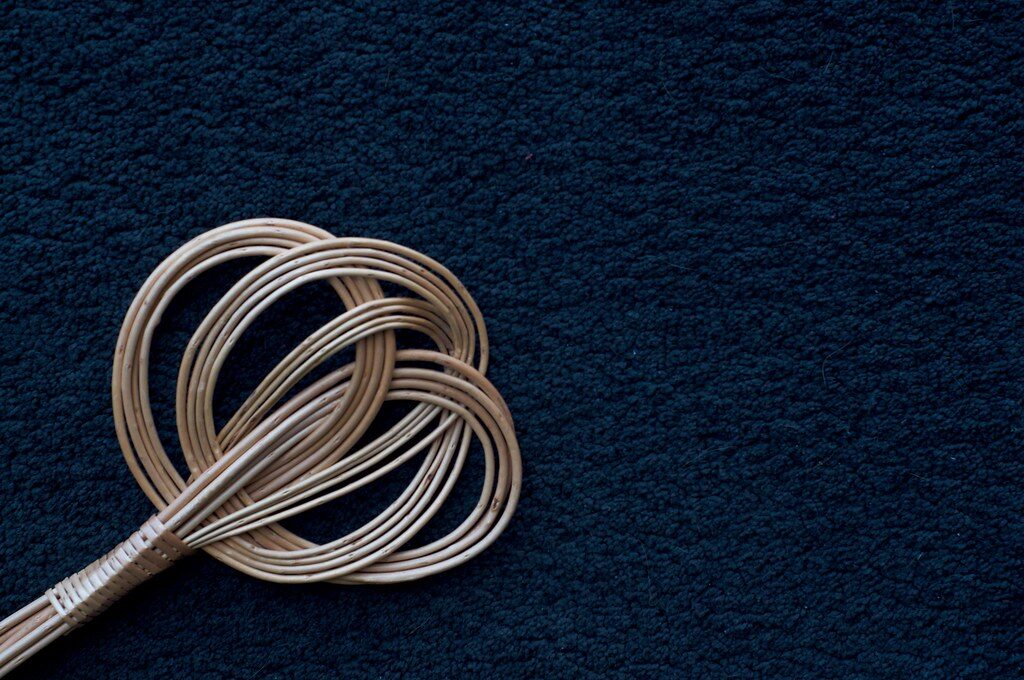
The carpet beater might be the most underestimated tool on this list, partly because it looks like nothing at all — a flat paddle of woven rattan, wicker, or coiled wire on a handle. Its job was to clean rugs and carpets in the era before the vacuum, and it did this by being draped over a line outdoors and struck, repeatedly, to knock loose the dust embedded deep in the fibers.
The looped, open design was not decorative. Carpet beaters were typically made of springy materials like rattan, cane, wicker, or spring steel, and the springiness was the entire point. A solid paddle would have transferred the impact to the surface of the rug and stopped there. The flexible, looped head flexed on contact, driving a shockwave deeper into the carpet and shaking dust out of layers a broom could never reach. The open weave also let air move through, so the beater pushed dust out rather than simply trapping it against the surface.
Beating carpets was hard physical work, and there’s no romanticizing that part. But the tool was genuinely effective in a way that’s easy to dismiss. It reached dirt that surface cleaning left behind, it required no power, and it doubled as a way to air out and refresh textiles that couldn’t be washed. Antique carpet beaters have become collectible precisely because the good ones were beautiful objects — but their beauty was a byproduct of a design tuned, loop by loop, to move dust with a flick of the wrist.
None of these tools vanished because they failed. They vanished because electricity arrived and offered the same results without the effort or the daily attention. That’s a fair trade, and almost nobody would give up their refrigerator to get the iceman back. But it’s worth remembering that the people who designed these objects were solving real problems with real ingenuity, using gears and convection and springy rattan instead of motors and compressors. The tools were never as simple as they looked. We just stopped needing to notice.