5 Things Found in Old Kitchens That Barely Exist Today
The kitchen has changed more than almost any room in the house, and it has changed fastest of all. A century ago, the kitchen was a workshop — a place of real, physical labor where food was processed nearly from scratch, heat came from burning wood, and every task demanded a specialized tool and a fair amount of muscle. The fixtures and appliances that filled that room were built for a kind of daily work that has almost entirely disappeared, absorbed by electricity, refrigeration, and the grocery store.
Look into a well-equipped kitchen from the early 20th century and you’ll find objects that a modern cook would struggle to identify, let alone operate. Here are five of them — things that once stood at the center of how families ate, and that have now nearly vanished from the rooms where they used to be indispensable.
The Hoosier Cabinet
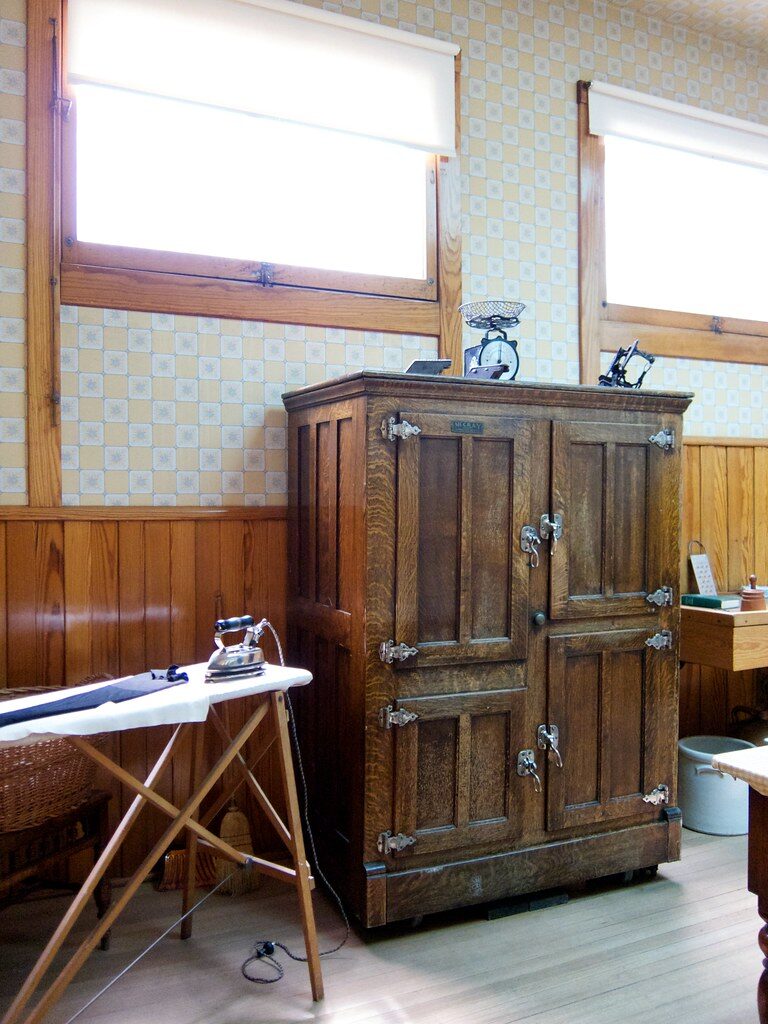
Before the era of built-in cabinetry and kitchen islands, the freestanding Hoosier cabinet was the organizational heart of the American kitchen. Founded in 1898 in Indiana, the Hoosier Manufacturing Company took a standard cupboard and reimagined it as a compact, all-in-one baking center — and the design was so successful that the brand name became the generic term for the whole category, the way “Kleenex” did for tissues.
What set the Hoosier apart was how much it packed into one piece of furniture. A typical unit included a tilt-out flour bin with a built-in sifter, a sugar bin, a spice rack, tin-lined drawers to keep bread fresh, a pull-out enameled work surface for kneading and mixing, racks for utensils, and shelves behind the doors. Many had a tambour door — a roll-top like a desk’s — to hide clutter, and some came with recipe charts or meal-planning guides printed right on the inside of the doors. It was a workstation engineered for efficiency decades before anyone used that word about a kitchen.
The cabinet’s popularity was staggering. By 1920, the Hoosier Manufacturing Company had sold over two million cabinets to American homeowners, often ordered through the Sears or Montgomery Ward catalogs and delivered by rail. Then, in the 1940s, it vanished almost as quickly as it had risen — not because it stopped working, but because built-in cabinetry became the new standard in home construction, and a freestanding all-in-one workstation was suddenly redundant. Today the Hoosier survives mostly as a prized antique, valued for exactly the clever, compact ingenuity that once made it a kitchen necessity.
The Wood-Burning Cookstove
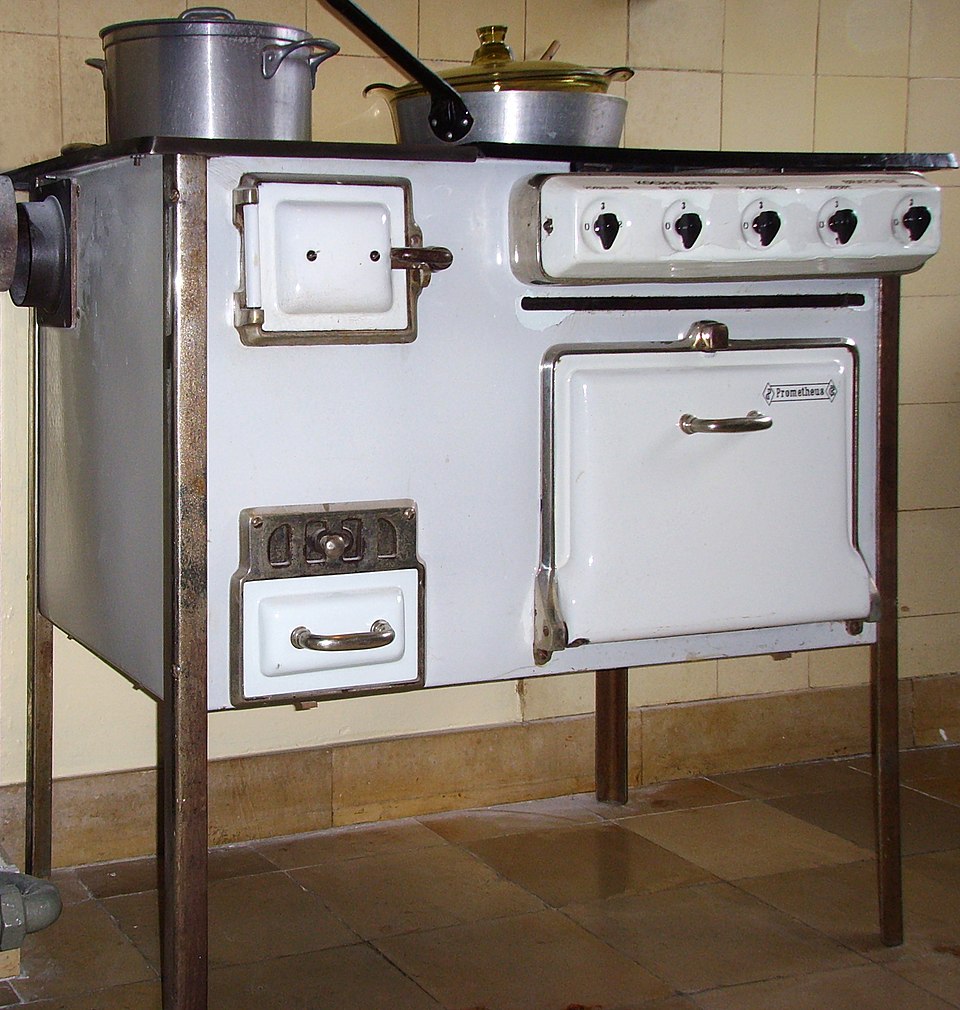
For most of the 19th century and well into the 20th, the kitchen was organized around a single massive object: the wood-burning cookstove. This was a heavy cast-iron appliance that served as the kitchen’s only source of cooking heat, and it ran on exactly what its name says — wood, fed by hand into a firebox and tended constantly to keep the temperature where it needed to be.
A typical cookstove was a marvel of integrated design. The firebox sat on one side, a water reservoir on the other, a baking oven in between, and a warming oven up above — so the same fire that cooked dinner also heated wash water and kept finished dishes warm. The cook controlled the heat not with a dial but with skill: choosing the right wood, managing the airflow, and knowing from experience which spots on the cast-iron surface ran hotter or cooler. There was no thermostat, only judgment.
Operating one was constant, demanding work. The fire had to be built, fed, and monitored; ovens had no temperature readout, so bakers learned to gauge the heat by holding a hand inside or watching how fast a sprinkle of flour browned. The stove also threw heat into the room year-round, a comfort in winter and a misery in summer. The arrival of gas and electric ranges — which delivered instant, controllable heat at the turn of a knob — made the wood cookstove obsolete for everyday use, and the daily labor of tending a kitchen fire passed out of ordinary life.
The Stovetop Percolator
For decades, the sound and smell of morning coffee in an American home came from a percolator — and for much of that time, a stovetop model with no electricity involved at all. An Illinois farmer named Hanson Goodrich patented the stovetop percolator design in 1889, and the basic mechanism stayed essentially unchanged for generations.
The way it worked was ingenious, if temperamental. Water in the bottom chamber was heated until it boiled, forcing it up a central tube where it sprayed over a basket of coffee grounds near the top. The brewed coffee then dripped back down into the chamber, only to be boiled and cycled up through the grounds again — over and over, until the cook decided it was strong enough. A glass knob on the lid let you watch the coffee darken with each cycle, “perking” away with its distinctive gurgle.
The trouble was that constantly recirculating boiling coffee over the grounds tended to produce a bitter, over-extracted, sometimes scorched brew, and the result depended heavily on the cook’s judgment about when to pull it off the heat. Percolators ruled American kitchens until 1972, when the Mr. Coffee automatic drip machine arrived and brewed coffee at a controlled temperature without the endless reboiling. The drip machine made a measurably better cup with no guesswork, and the stovetop percolator faded to a piece of camping equipment and nostalgia — though a few devotees still swear by the gurgle.
The Butter Churn
In a great many households, especially rural ones, butter was not something you bought — it was something you made, by hand, from cream, using a butter churn. The churn was a fixture of the kitchen or the back porch, and operating it was a familiar, repetitive chore often handed to children.
The principle is simple physics: agitate cream long enough and the fat globules collide, clump together, and separate from the liquid buttermilk, eventually forming solid butter. The churn was the machine for doing that agitation. Early versions were tall wooden cylinders worked with a plunger called a dasher, pumped up and down by hand; later models used a crank to turn paddles inside a glass or stoneware jar, which was easier but still demanded sustained effort. Depending on the temperature of the cream and the vigor of the churning, the process could take anywhere from several minutes to the better part of an hour.
Making butter at home was ordinary because the alternative — buying it — wasn’t always practical before refrigeration and reliable distribution put fresh dairy on every grocery shelf. Once it did, the daily or weekly ritual of churning simply evaporated. A task that had occupied countless kitchen hours across generations became unnecessary almost overnight, and the churn went from essential equipment to the kind of object that now turns up as a decorative antique on a porch, often with no one in the household quite sure how it worked.
The Pie Safe
Before the icebox, and long before the refrigerator, the problem of keeping food safe from insects and vermin while still letting it breathe was solved by a piece of furniture called the pie safe. It was an important part of the American household starting in the 1700s and continuing through the 1800s, likely introduced by German immigrants who settled in Pennsylvania and became known as the Pennsylvania Dutch.
The pie safe was a wooden cabinet, roughly the size of a large bureau, designed to store pies, bread, meat, and other perishables out of reach of pests. Its defining feature was ventilation: the doors and often the sides were fitted with tin panels punched full of small holes, which let air circulate through the cabinet while keeping flies and mice out. The punched-tin panels were frequently worked into decorative patterns — stars, eagles, hearts, sometimes elaborate scenes — turning a practical food-storage cabinet into a genuine piece of folk craftsmanship.
The pie safe answered a real and constant problem in a world without sealed packaging, screens on every window, or any way to refrigerate food. As iceboxes and then electric refrigerators took over the job of preserving perishables — doing it better, and cold — the pie safe lost its purpose entirely. It survives now almost exclusively as an antique prized for its punched-tin artistry, a beautiful solution to a problem that modern kitchens no longer have.
What all five of these objects share is that they were built for a kitchen that functioned as a place of production rather than assembly. When food had to be processed from raw materials, kept cold without electricity, and cooked over a fire you tended yourself, each of these tools earned its place. The conveniences that replaced them — the refrigerator, the gas range, the grocery store’s dairy case, the drip coffee maker, the built-in cabinet — didn’t just make the old objects optional. They quietly dismantled an entire way of working that had defined the kitchen for centuries. The room looks calmer now. It used to be where a great deal of the day’s hardest labor got done.