The deepest parts of the ocean are essentially a separate planet. Below about 200 meters, sunlight stops penetrating. Below 1,000 meters, even the most stubborn blue wavelengths give up. The pressure is crushing, the temperature hovers just above freezing, and food is so scarce that a single carcass falling from the surface can feed an ecosystem for years. The animals that live down there are not modified versions of the fish you see at the aquarium. They are built for a world we are barely able to visit, and many of them were not even described by science until research submersibles became routine in the 1980s.
What follows are five real creatures, all of which are alive in the ocean right now. They were not designed by a film studio, even though they look like they were. Each one solves a specific engineering problem the deep sea imposes — finding light, finding food, finding a mate, surviving long enough to do any of it — in a way that, in the world above, would be considered science fiction.
The Barreleye Fish Has a Transparent Head and Eyes That Rotate Inside It
The barreleye (
Macropinna microstoma) was first described in 1939, but for nearly seventy years, nobody knew what it actually looked like. Specimens were always hauled to the surface in nets, and the most distinctive feature of the animal — a transparent, fluid-filled dome covering the top of its head — was always destroyed in the process.
Then, in 2008, two researchers at the Monterey Bay Aquarium Research Institute, Bruce Robison and Kim Reisenbichler, finally got
video of a living barreleye at depths of 2,000 to 2,600 feet off Central California. The remotely operated vehicle's lights revealed the dome. They also revealed something stranger. Behind that transparent shield, the barreleye has two bright green, tubular eyes — and the eyes rotate within the dome like ball turrets in an old aircraft, able to swivel from straight up to forward-facing.
This solves what Robison called the paradox of the barreleye. For decades, scientists assumed the eyes were fixed pointing upward, allowing the fish to spot the silhouettes of prey against the dim light filtering down from far above. But fixed upward-facing eyes would make it impossible for the fish to see its own mouth, let alone capture food. The dome and the rotating eyes resolve this: the fish hangs motionless in the water, eyes pointed up, watching for prey overhead. When something is spotted, it tilts its body to a vertical position, rotates its eyes to forward-facing, and strikes. The transparent shield may also protect the eyes from the stinging tentacles of siphonophores, which the barreleye is suspected of stealing food from. It is, essentially, a deep-sea sniper with a periscope.
The Vampire Squid Turns Itself Inside Out and Glows in Self-Defense
Despite the name, the vampire squid (
Vampyroteuthis infernalis, "vampire squid from hell") is neither a vampire nor really a squid. It is the only surviving member of an ancient cephalopod order that branched off from octopuses and squids long before either group existed in their modern form. It lives in the oxygen minimum zone, between roughly 600 and 1,200 meters down, in waters with less than 10 percent of normal surface oxygen. It is roughly the size of a football, reddish-brown, with eight arms connected by a webbed cloak and two enormous blue eyes that look like sapphires.
It does not eat blood.
In 2012, MBARI researchers Henk-Jan Hoving and Bruce Robison published the first proof that vampire squid eat "marine snow" — the constant slow drizzle of dead plankton, fecal pellets, and gelatinous debris falling from the surface. The squid extends two long, sticky filaments into the current, collects particles, then scrapes them off and folds them into a mucus packet for consumption. It is the only known cephalopod that does not actively hunt living prey.
The defense is where it gets cinematic. With no ink (ink would be useless in pitch darkness), vampire squid have evolved an alternative.
Robison's lab documented two never-before-described bioluminescent defenses in 2003. When threatened, the tips of all eight arms light up with pulsing blue bioluminescence — a confusing, disorienting fireworks display. If the threat persists, the squid releases a glowing cloud of luminous mucus and pulls its webbed arms over its head, inverting its body and exposing rows of fleshy, spiky-looking projections called cirri. It now looks like an entirely different animal — larger, spinier, glowing — while the bioluminescent cloud distracts the predator. It is a single creature pulling off three optical illusions at once.
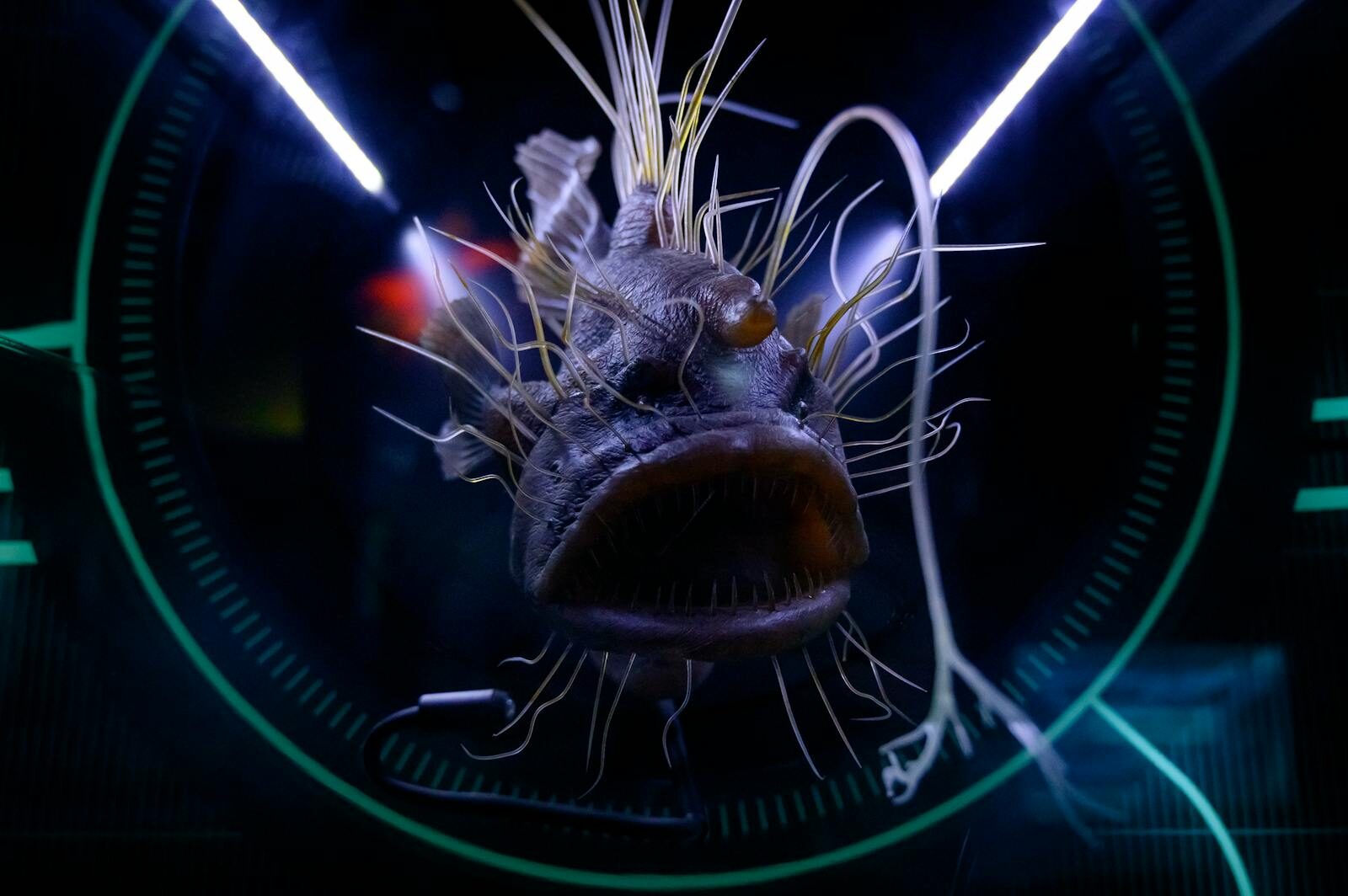
The Anglerfish Permanently Fuses to Her Mate's Body
Deep-sea anglerfish are famous for the bioluminescent lure dangling above their faces — a glowing bait, produced by symbiotic bacteria, that draws curious prey within reach of an enormous, tooth-filled mouth. This image, popularized by the film
Finding Nemo, only describes the females. The males are barely the same animal.
In many deep-sea anglerfish species, the male is a tiny, dwarfed creature roughly the size of a grain of rice, with no lure, no functional digestive system, and almost nothing in the way of internal organs. What it does have is an extraordinary sense of smell, used to locate a female in the vast emptiness of the deep ocean. When a male finds one, he bites into her side and never lets go. His mouth fuses with her flesh. Their circulatory systems join. His body atrophies until little remains except a sac of testes hanging from her flank, drawing nutrients from her bloodstream and providing sperm on demand. A single female can carry up to six fused males at once.
This phenomenon, called sexual parasitism, was first observed in 1920 by an Icelandic fisheries biologist who thought he was seeing two different species of fish stuck together. The biology baffled researchers for the next century. In vertebrates, attaching one body to another is supposed to trigger immediate immune rejection — the same response that complicates human organ transplants. How were anglerfish doing this without dying?
The answer arrived in 2020, when a team led by Thomas Boehm at Germany's Max Planck Institute of Immunobiology and Theodore Pietsch at the University of Washington
published a genomic analysis in Science. They found that anglerfish species that practice sexual parasitism have
disabled key genes in the adaptive immune system — including some considered essential in every other vertebrate. They have effectively traded away the ability to produce antibodies in exchange for the ability to fuse with another body. The female accepts the male the way an immunosuppressed transplant patient accepts a donor organ, except permanently. The implications for human immunology are still being worked out.
The Sea Pig Walks the Abyssal Plain in Herds
The sea pig (
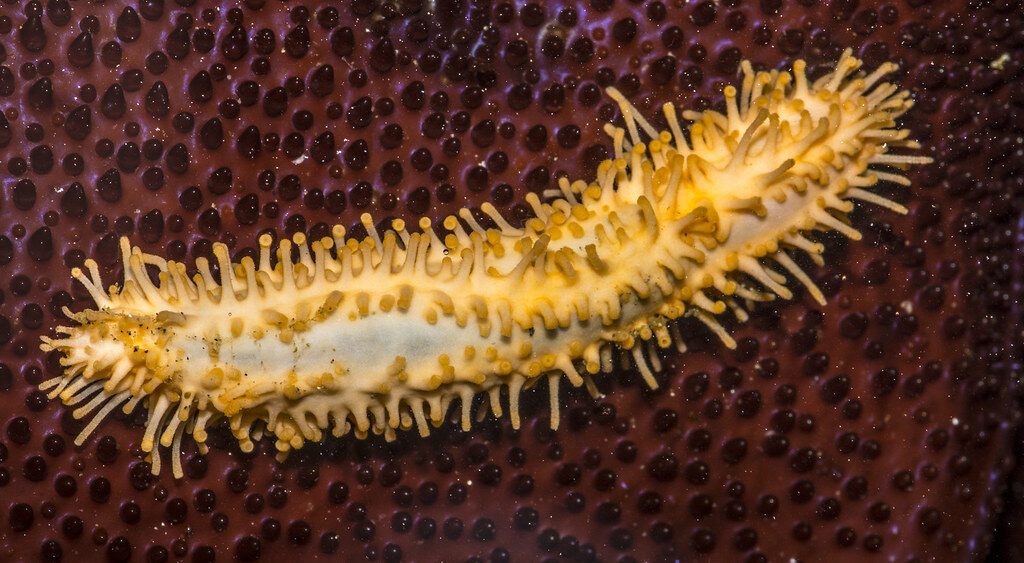
Scotoplanes globosa) is a holothurian — a sea cucumber — that has rebuilt itself into something that walks. It is roughly the size and shape of a small pink potato, with five or six pairs of inflated, leg-like appendages along its underside. These appendages are not true legs. They are water-filled extensions of the sea pig's hydraulic system, called tube feet, which it pumps full of water to extend and stiffen, then uses to amble slowly across the seafloor.
Sea pigs live on abyssal plains at depths between 1,000 and 6,000 meters, where they hoover up the upper layer of sediment for traces of organic material — bits of dead plankton, microbes, the leftovers of marine snow. They are not rare. They are, in fact, sometimes the most abundant large invertebrate at their depth, congregating in herds of hundreds, all facing the same direction into the current. This formation appears to maximize each animal's chance of detecting drifting food.
What looks alien about the sea pig is exactly what makes it work. Without water pressure to fight, it doesn't need a skeleton or muscle in any conventional sense. Without daylight, it doesn't need camouflage. Its body is a soft, pressurized sack walking on hydraulic stilts. It carries small commensal animals — juvenile king crabs, tiny worms, even snails — hiding under its body, which means a single sea pig is also a roving habitat for other species. It is an entire ecosystem the size of a baking potato, walking slowly across the abyssal floor.
The Frilled Shark Has Been Pregnant for Three and a Half Years
Most descriptions of the frilled shark (
Chlamydoselachus anguineus) start with the word "primeval," and that is appropriate. The species belongs to a lineage roughly 80 million years old, predating the extinction of the dinosaurs. It looks the part. The body is long, slender, and eel-like, growing to about two meters. The head is broad and flat. The mouth is filled with about 300 needle-like teeth arranged in 25 rows. The gill slits — six pairs of them, one more than nearly any other shark — have ruffled, frilly edges that give the animal its name.
For most of the species' time in scientific knowledge, all anyone had to study were the occasional specimens that turned up in deep-sea fishing nets, usually dead.
The first video of a living frilled shark was not recorded until 2004, when one happened to swim up near the surface off Japan, apparently disoriented or dying. The footage is brief, slow, and unsettling. The shark moves with the rippling, full-body undulation of an eel rather than the rigid side-to-side sweep of a modern shark.
The most extraordinary fact about the frilled shark, however, is its reproductive cycle.
Females are estimated to carry their young for up to 3.5 years before giving birth — the longest known gestation of any vertebrate animal, exceeding even elephants by more than a year. Embryos develop inside the mother, fed by yolk rather than placenta, growing at a glacial pace appropriate to a metabolism set for the cold and food-scarce deep. The exact gestation length has never been measured directly because no one has ever observed a frilled shark pregnancy in captivity from start to finish; the figure comes from
embryonic growth rates studied across captured specimens. A frilled shark gives birth perhaps once in a decade. It eats squid and other sharks, swallowing them whole. It does not know dinosaurs are gone.