7 Social Rules Everyone Follows Without Questioning Them
The rules nobody taught you are the ones running most of public life. They’re invisible to the people who follow them, become acutely visible the moment somebody breaks them, and have names — usually coined by sociologists who got their PhDs documenting them with notebooks on benches. Seven of the silent rules of American (and sometimes global) public conduct, the researchers who first identified them, and the breaching experiments that made the invisible briefly visible. The surprise is usually that there’s a name for it at all.
When you pass a stranger on the sidewalk, you give them a brief glance from about eight feet away and then drop your gaze — anything else feels wrong
Erving Goffman called this “civil inattention” in his 1963 book Behavior in Public Places. The ritual: glance directly at an approaching stranger from a few yards out to acknowledge their personhood, then drop your gaze before passing. Don’t stare (threatening). Don’t refuse to look (rude or fearful). Goffman called it “a kind of dimming of lights” — the non-verbal “I see you, I’m not a threat, you’re not prey.”
His larger argument was that civil inattention is what creates public space at all. It’s not the absence of interaction — it’s an active, choreographed micro-ritual performed thousands of times a day. Without it, you’d either feel surveilled or feel invisible. Which is also why phone-staring on the subway feels rude: it withholds the micro-acknowledgment that other people are people.
If you want to test the rule’s grip, try staring at strangers on a sidewalk for four seconds each, holding eye contact through the pass. You’ll feel the social fabric tear before anyone says a word.
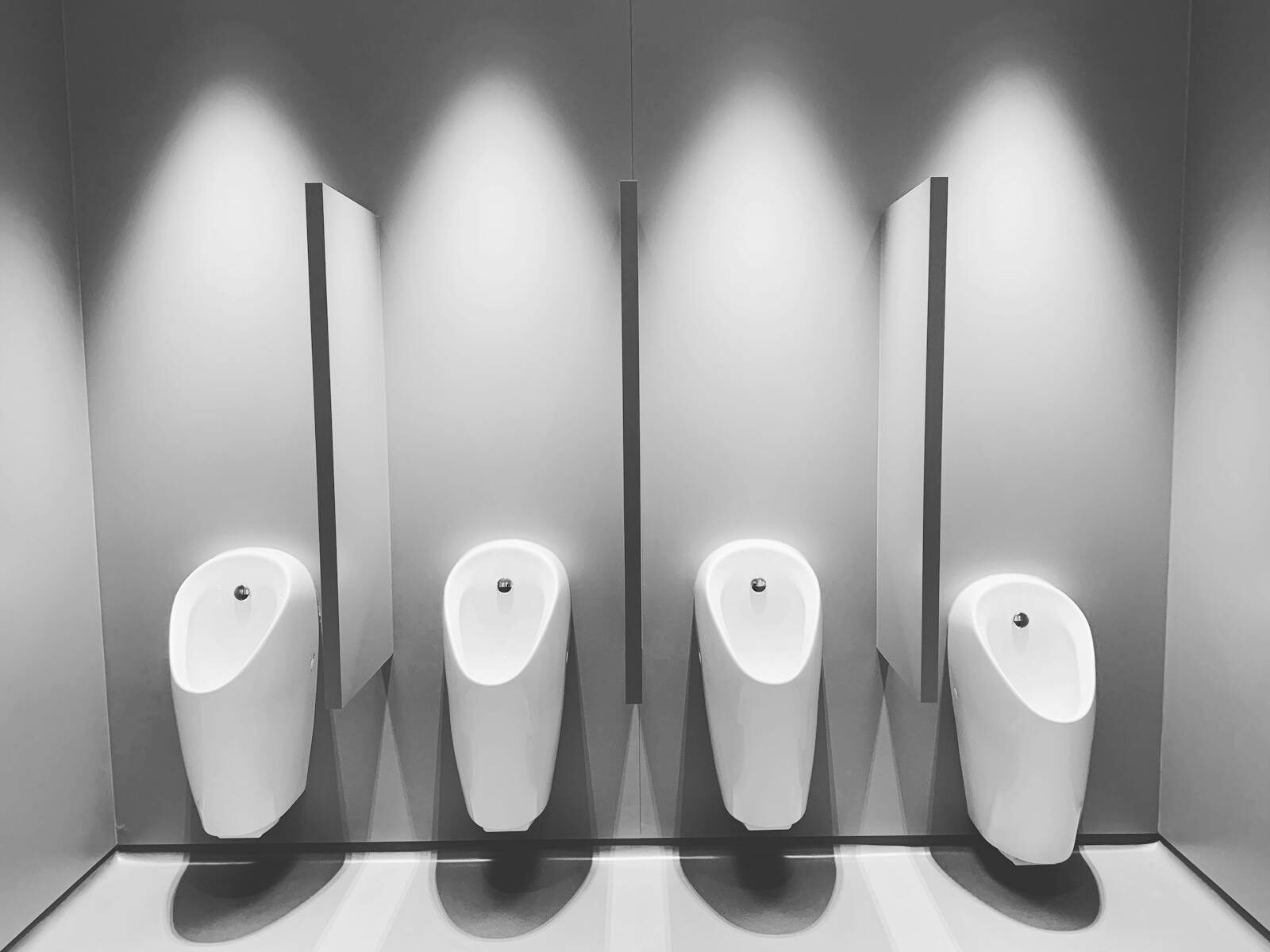
Men instinctively pick the urinal farthest from any occupied one — and breaking the rule will measurably slow their actual urine flow
This one has the rare distinction of being a social-norm study where the body itself is the dependent variable. Middlemist, Knowles, and Matter’s 1976 paper in JPSP stationed confederates either immediately adjacent or one urinal away from a target. A hidden observer in a stall used a periscope to time urination onset and duration.
Close-stand violations significantly delayed urine onset and shortened flow. The proxemic norm registers at the level of the involuntary nervous system. The bladder snitches on the brain.
It’s also notorious as one of psychology’s most ethically dubious studies — a periscope in a stall — and now gets taught as a research-ethics case study alongside the substantive finding. The “rule” isn’t really learned. It’s enforced by a physiological feedback loop most men have never consciously noticed.
You have roughly 200 milliseconds to respond when someone asks you a question — across every human language on Earth
Tanya Stivers and colleagues’ 2009 PNAS paper recorded informal conversations in ten unrelated languages on five continents: Tzeltal Mayan, Yélî Dnye, Japanese, Italian, Korean, ‡Ākhoe Hai‖om, Danish, English, and others. They measured the gap between yes/no questions and their answers. Median gaps clustered between 0 and 300 milliseconds in every language tested.
This is one of the strongest candidates for a true human universal — tighter than color terms, kinship structure, or grammatical features. You can hear someone fumble it in real time: a 700ms pause after “Do you want to come for dinner?” already means “no,” before the actual answer arrives. Speakers begin planning their replies before the question finishes, which means conversation is a predictive sport, not a sequential exchange.
Baselines shift slightly by culture. Median gap in Japanese: about 7ms. In Danish: about 469ms. A Dane and a Tokyoite in conversation both feel the other is being rude — for opposite reasons, on different sides of the same universal.
A queue is a moral system that materializes within seconds, polices itself, and licenses retaliatory aggression from bystanders not directly affected
Richard Larson’s 1987 Operations Research paper on the psychology of queueing found that wait experience is dominated less by duration than by perceived fairness. Larson’s phrase: “any deviation from first-come-first-served is, to most, a mark of iniquity and can lead to violent queue rage.” Milgram’s 1986 field experiments on intrusion into waiting lines confirmed the moral framing — when confederates cut in, bystanders behind the intruder, not just those immediately displaced, often physically intervened to enforce the norm.
A queue is a spontaneous social institution. Order is fixed at the moment of arrival, with no announcement or visible marker. There’s no enforcement mechanism beyond consensus. People will sometimes physically restrain strangers to maintain it.
The deeper finding from Milgram: when his confederates simply stood in line silently after cutting, the violation was felt as more grievous than open queue-jumping with apology. The silence broke the assumption that everyone shares the same rulebook, which turns out to be more upsetting than breaking the rulebook itself.
Asking a seated subway passenger to give up their seat for no reason is so socially difficult that the asker often physically cannot make the request — and that’s how Milgram proved the rule existed
Stanley Milgram and his graduate students ran a quiet experiment in the New York City subway in the 1970s. The task was simple: approach a seated stranger and politely ask for their seat, with no justification. About 56% of those asked actually complied — that’s not the surprising part.
The surprising part was the askers. Milgram himself reported intense psychosomatic difficulty even approaching strangers to make the request. One graduate student described being nearly unable to speak. Milgram tried it personally and felt physically ill. He said the discomfort was unlike anything he’d encountered in his much more famous obedience studies.
Most people predict that the seated stranger will suffer most from the breach. In reality, the asker bears the cost. That inverts the popular intuition about confrontation. It also operationalizes Garfinkel’s central insight: the social order isn’t just rules people follow. It’s a structure whose existence is signaled most clearly by the visceral panic of trying to violate it.
Stand right, walk left — and forcing everyone to stand on both sides would move 35% more people per minute, except nobody will do it
In the UK, Hong Kong, and most of mainland China: stand-right, walk-left on the escalator. In Australia, Singapore, and most of Japan (Osaka excepted, for no documented reason): stand-left, walk-right. Sides flip by city. The convention emerges and stabilizes without signage.
In 2015-2016, Transport for London ran a trial at Holborn station forcing all passengers to stand on both sides during peak hours on the long escalators. Observed throughput rose from about 81 to 113 passengers per minute — over 35% more people moved. Despite the data, riders refused to comply, glared at the staff, and the trial was abandoned.
The popular explanation (“we stand right because it’s efficient”) is wrong. Staggered-side use is measurably less efficient on long escalators. The norm persists because it solves a different problem — a coordination question about who gets to decide they’re in a hurry — and the convention has a documented birth date (1921, Earl’s Court “shunt” escalator dumped passengers off on the left, and the etiquette calcified around it).
Smiling at strangers isn’t universal — in Russia, Iran, South Korea, and several other countries, an unprovoked smile gets you rated as either stupid or dishonest
Kuba Krys and colleagues’ 2016 study in the Journal of Nonverbal Behavior rated smiling versus non-smiling individuals across 44 countries. In countries scoring low on the GLOBE Uncertainty Avoidance index — Iran, India, Russia, Argentina, Zimbabwe, South Korea, France — smiling individuals were rated as less intelligent than their non-smiling counterparts. In cultures scoring high on corruption indices — Russia, India, China, Argentina — smilers were rated as less honest.
A related Krys paper riffed on the Russian proverb смех без причины — признак дурачины: “laughter without reason is a sign of foolishness.” The mechanism: in low-trust, high-corruption societies, unprompted positive affect is suspicious, because there’s no obvious reason for a stranger to be cheerful. Either they want something from you or they’re not sharp enough to see what’s going on.
Most Americans assume smiling is a universal pro-social signal. Krys’s data demolishes that. The American customer-service smile is a cultural artifact, not a biological one — likely linked to a high-mobility immigrant society where rapid trust-signalling between strangers had to be built without shared kinship or background to fall back on.
The reason it’s hard to see these rules is the same reason it’s hard to taste your own saliva — you’re always already inside them. Until someone breaks one, the rule is invisible. The moment they do, it’s the only thing in the room.