5 Nervous Habits People Don’t Know They’re Doing
Sit in a busy coffee shop for ten minutes and watch the hands. Someone in your line of sight is bouncing a leg. Someone else is biting the side of their thumbnail in tiny, distracted movements while reading. The man at the next table is rolling a pen between his fingers without looking at it. The woman in line is twisting a section of her own hair around her index finger, releasing, twisting again. None of them know they’re doing it. If you asked, most would deny it, then catch themselves doing it again within sixty seconds.
These behaviors have a name. Clinicians call them BFRBs — body-focused repetitive behaviors — when they cross a threshold of severity, and the broader category of self-soothing, self-regulating motor habits when they don’t. The DSM-5-TR formally recognizes two of them as disorders: trichotillomania (compulsive hair-pulling) and excoriation (compulsive skin-picking). The others — nail-biting, jaw-clenching, leg-bouncing, lip-biting, finger-tapping — sit on a continuum from harmless tic to clinical concern. The research suggests they share an underlying purpose. The body is trying to regulate something the mind hasn’t put words to yet.
Nail-Biting
Onychophagia — the clinical term for chronic nail-biting — is one of the most common nervous habits on the planet. Prevalence estimates put BFRBs collectively at 0.5% to 4.4% of the population, but counts of milder nail-biting in children and adolescents reach as high as 30% in some surveys. Most people who do it picked up the habit before age ten and continued into adulthood without noticing the transition.
What makes nail-biting interesting from a research standpoint is that it doesn’t fit neatly into the categories psychologists like to use. It isn’t always a stress response — many chronic biters bite while concentrating, reading, or watching television, in states that don’t feel particularly stressful. It isn’t pure boredom either, since many sufferers report engaging in the behavior during periods of intense focus. The current consensus is that nail-biting functions as a regulator of arousal, pulling the nervous system toward an optimal level when it drifts too high (anxiety) or too low (boredom or under-stimulation).
The behavior is genuinely involuntary in the sense that most biters cannot stop without active intervention. Habit-reversal training, the first-line behavioral treatment, works by interrupting the chain of small movements that precede the bite — the moment when the hand begins drifting toward the mouth, before contact occurs. Patients are trained to notice the precursor and substitute a competing response, like clenching the fist. The research on N-acetylcysteine, a glutamate-modulating supplement, has shown some promise for severe cases. The behavior is so durable because, by the time the biter notices, the bite has already happened.
Leg-Bouncing and Foot-Tapping
The bouncing leg is the most public of the nervous habits, partly because chairs amplify it and partly because the person doing it almost never realizes anyone can see. Foot-tapping and leg-jiggling fall under the broader research category of fidgeting, and fidgeting has been studied seriously for the past two decades — long enough to overturn most of what people assume about it.
The conventional wisdom is that fidgeting indicates anxiety, restlessness, or inability to concentrate. The research has been steadily complicating that picture. Karen Pine, a psychologist who spent her career at the University of Hertfordshire, ran a series of studies showing that children who were allowed to fidget with their hands performed better on memory and learning tasks than children who were forced to sit still. A 2024 study of 70 adults with ADHD published in Frontiers in Psychiatry measured fidgeting movements with actigraphy devices during a cognitive control task — the Flanker test — and found that participants fidgeted more during correct trials than incorrect ones. Participants with the most consistent reaction times fidgeted more during the later, harder phases of the task.
The interpretation that has emerged is that fidgeting is the body’s way of maintaining an arousal level that keeps the cognitive system engaged. Holding still requires the brain to spend resources suppressing motor activity — resources that would otherwise be available for the task at hand. When the demand on attention rises, the system releases the brake on small movements, and performance often improves. The bouncing leg under a desk in a meeting may not be a sign that the person isn’t paying attention. It may be the mechanism by which they are.
Hair-Twirling and Hair-Pulling
Hair-twirling exists on a continuum with one of the two formally classified BFRBs. The mild version — winding a section of hair around a finger while reading or talking — is common across the population and probably means nothing pathological in most cases. The severe version is trichotillomania, the compulsive pulling of hair from the scalp, eyebrows, or eyelashes, often resulting in patches of hair loss the sufferer goes to elaborate lengths to hide.
Trichotillomania most often appears in adolescence, frequently coinciding with the onset of puberty, and disproportionately affects women — though the gender gap may partly reflect underreporting in men. People with the disorder describe an irresistible urge to pull, often preceded by a building sensation of tension and followed by a brief release. Many pullers report a specific, almost ritualistic process: locating a particular type of hair (coarser, curlier, in a specific spot), pulling it, examining it, and in some cases biting the root before discarding it.
What makes the milder version of this behavior worth thinking about is how rarely people notice they’re doing it. The hand drifts up, the finger finds a section of hair, the winding begins, and unless someone points it out or the hair pulls hard enough to register pain, the entire sequence can run on autopilot. Researchers studying BFRBs increasingly view these habits as belonging to a family of self-regulating behaviors that the brain has automated below the threshold of conscious access. The motor program is stored in the basal ganglia, the same set of structures responsible for procedural memory — riding a bike, tying shoes, brushing teeth. Once the program is in there, it runs without supervision.
Skin-Picking and Lip-Biting
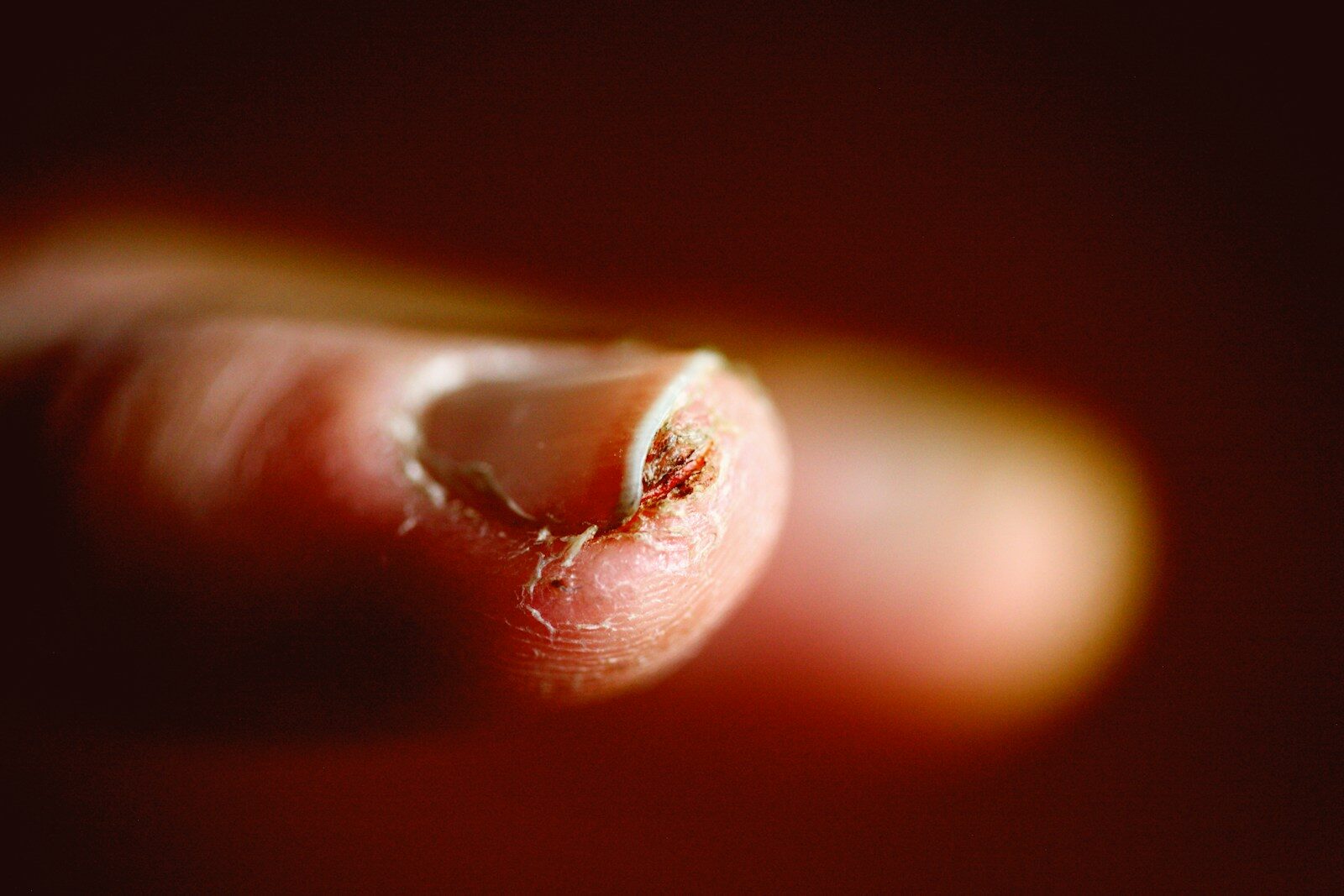
The second formally classified BFRB is excoriation disorder, also called dermatillomania — compulsive skin-picking that causes lesions, scarring, or significant distress. The milder forms of the behavior pattern are everywhere: picking at a hangnail, peeling skin around the cuticles, biting the inside of the lower lip, scratching at a healing scab past the point of usefulness. The compulsive end of the spectrum can cause infections, permanent scarring, and in extreme cases serious medical complications.
The behavior is notably tactile in a way that distinguishes it from other nervous habits. Pickers describe seeking out specific textures — a raised edge, a rough patch, a piece of skin that doesn’t feel right — and report a sensation of completion when the imperfection is removed. The Anxiety and Depression Association of America notes that the evidence-based treatments for BFRBs fall under the umbrella of cognitive behavioral therapy, with the two primary interventions being Habit-Reversal Training and the Comprehensive Behavioral Treatment Model, which breaks each BFRB into five components — sensory, cognitive, affect, motoric, and place — and addresses each separately.
Lip-biting deserves special mention because it is so easy to miss. Many chronic lip-biters injure themselves to the point of producing small calluses or sores on the inside of the lip, and have no idea they’re doing it. The behavior tends to spike during periods of focused concentration — writing, driving, reading — when the conscious mind is occupied with the task and the small motor habits of the mouth and tongue run unsupervised. People in long-term relationships will often notice their partner doing this and bring it up. The partner is usually surprised.
Jaw-Clenching and Teeth-Grinding
Bruxism — the clinical term for chronic teeth-grinding and jaw-clenching — is so common that dentists check for the signs at routine cleanings. The molars of long-term bruxers show telltale flattening on the chewing surfaces. The jaw muscles, particularly the masseter, can become hypertrophied from constant low-grade contraction. Headaches that originate at the temples and radiate forward are often bruxism in disguise.
Most bruxism happens during sleep, where the person clenching is by definition unaware. But a substantial subset of the behavior also happens during the day, in moments of stress, concentration, or even rest, and many awake bruxers are entirely unconscious of it. The jaw is one of the body’s primary holding sites for tension — the masseter is, pound for pound, one of the strongest muscles in the human body, and the brain seems to use it as a default destination for excess sympathetic-nervous-system activity. People who pay attention to their jaws during stressful conversations often discover, with some surprise, that they have been clenching the entire time.
Treatment options range from custom-fitted night guards (which protect the teeth without addressing the underlying clenching) to biofeedback, stress reduction, and in severe cases botulinum toxin injections into the masseter to weaken the muscle. The behavior is hard to extinguish because it operates almost entirely outside conscious awareness, and because — like the other habits on this list — it appears to serve a real regulatory function in the nervous system. The brain is using the muscle to do something. The fact that the muscle is in the jaw is incidental. If you blocked the jaw entirely, the tension would surface somewhere else.
The thing all of these habits have in common, and the reason they’re so hard to recognize in yourself, is that they’re not designed to reach consciousness. They are the work of the older, less verbal parts of the nervous system, running quiet maintenance on an arousal level the conscious mind isn’t tracking. Calling them “nervous habits” overstates the nervous part. They are regulatory behaviors that mostly happen in calm conditions, by people who would describe themselves as fine. They are also, in their milder forms, almost universal. If you don’t have any of them, you have a different one that didn’t make this list.