6 Old-School Skills Most People Don’t Learn Anymore
Every generation gives up a set of skills that the previous one considered baseline competence. Your great-grandmother could probably hand-can a winter’s worth of tomatoes, take a 200-words-per-minute meeting in shorthand, and find her way across an unfamiliar state with a folded paper map and the position of the sun. You can probably book a flight on your phone in 90 seconds. Both skill sets are real, and the trade isn’t pure loss — but it isn’t pure gain either, and the cognitive research on what we lose when we offload these skills is more interesting than the usual hand-wringing about it. Six skills that have nearly vanished within living memory, and what the actual research says about each one.
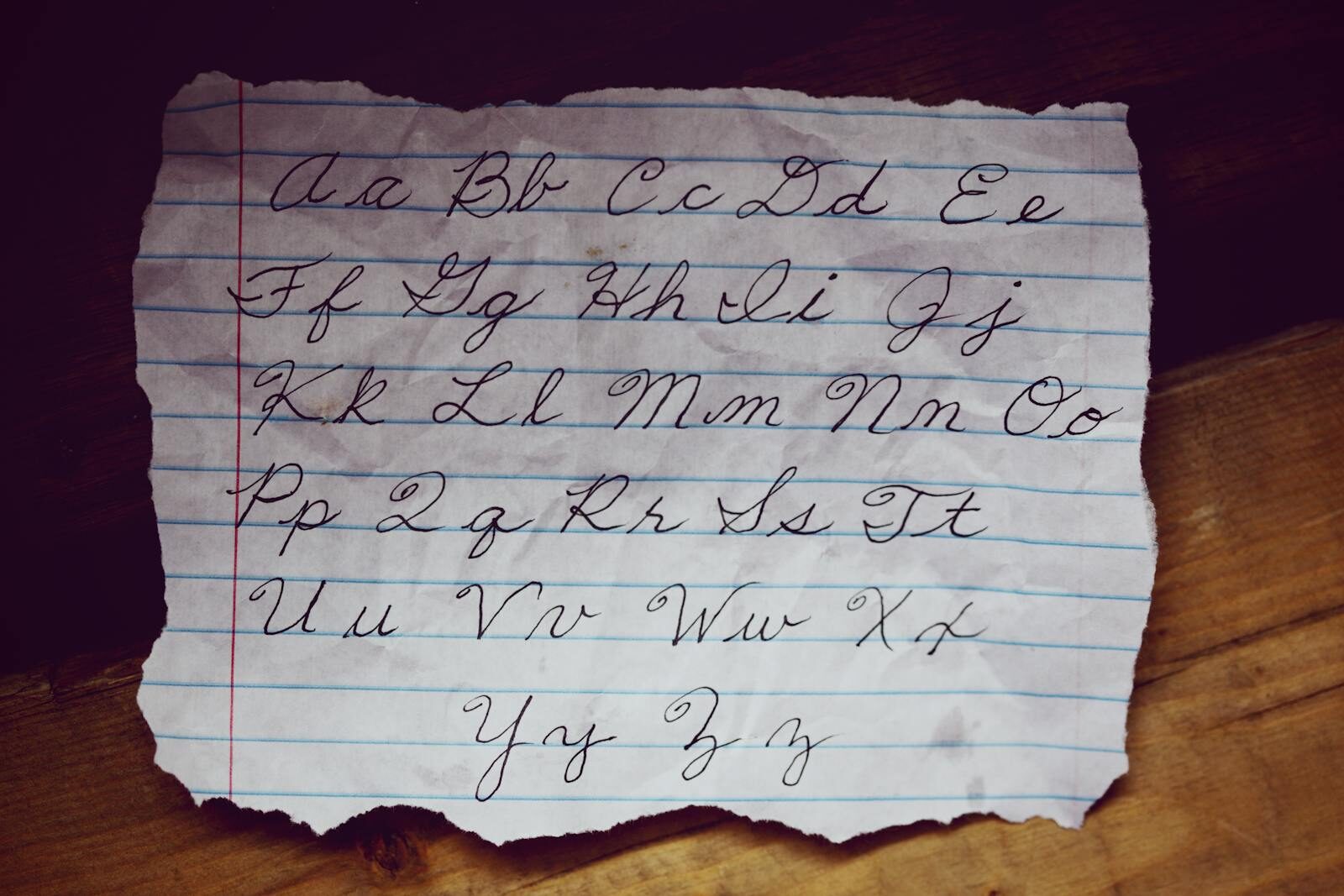
Cursive handwriting was dropped from U.S. schools in 2010 — and a 2023 brain study found the loss may matter more than the calligraphy itself
The Common Core State Standards launched in 2010 omitted cursive from K-12 requirements, and cursive instruction collapsed nationally over the following decade. About 22 states have since reversed course and re-mandated it, including California in 2024.
The most-cited piece of evidence in the cursive-revival argument comes from Audrey van der Meer’s lab at NTNU in Norway. Her 2023 study in Frontiers in Psychology used a 256-channel EEG sensor array to compare brain activity in adults and 12-year-olds while they either wrote words by hand with a digital pen or typed the same words on a keyboard. The handwriting condition produced widespread brain connectivity in theta and alpha bands across visual, sensory, and motor regions — the patterns associated with memory formation. Typing produced almost none of that connectivity.
One important caveat: Karin Harman James of Indiana University has noted there’s no conclusive evidence the benefit is specific to cursive versus print handwriting — the effect is from hand-writing in general. Which means the “save cursive” debate is somewhat beside the point. The real loss is writing by hand at all.
Reading a map without GPS uses a part of your brain that, in habitual GPS users, measurably shrinks
The first thing the U.S. military did on May 2, 2000 was disable Selective Availability — the artificial degradation of civilian GPS signals — making consumer turn-by-turn navigation suddenly viable. Smartphone navigation took over after 2008. Within fifteen years, paper map reading had effectively disappeared as a routine skill.
Eleanor Maguire’s UCL lab spent decades studying London taxi drivers, who must memorize 25,000 streets and 100,000 landmarks to pass “The Knowledge” exam. Her 2006 follow-up in Current Biology tracked trainees over years and found that only those who actually passed the exam showed measurable growth in the posterior hippocampus — the brain region encoding spatial memory. Failed trainees didn’t. The taxi drivers study became the cleanest demonstration that navigation literally builds brain tissue.
Véronique Bohbot’s 2020 study at McGill’s Douglas Research Centre ran the experiment in reverse. She found that habitual GPS users showed worse spatial memory on follow-up testing three years later than peers who navigated unaided. The brain’s spatial-memory system behaves like muscle: it grows under load and atrophies in disuse. Bohbot’s full GPS study remains the most-cited evidence that offloading navigation has a real cognitive cost.
The skill of mending a torn garment has collapsed so completely that 26% of UK adults can’t sew on a button
Cheap clothing has reset the entire economics of textiles in one generation. Global apparel production roughly doubled between 2000 and 2015, and the Ellen MacArthur Foundation calculates that clothing usage has fallen about 36% over the last 15 years — meaning the average garment is now worn fewer times before being thrown out.
The skill gap behind that shift is documented in WRAP UK’s Valuing Our Clothes reports. Their surveys found that 26% of UK adults are not confident sewing on a button, and 44% can’t stitch a hem. The skills that allowed a single sweater to last a decade — darning, patching, hemming, mending — were universal home knowledge through the 1950s and have now functionally disappeared.
The Ellen MacArthur Foundation’s deep dive on the circular economy calculates that repairing a single garment extends its life by an average of 1.3 years, and extending a garment’s wear life by just 9 months cuts its carbon, water, and waste footprint by 20 to 30%. The economics that killed mending are now the same economics making it relevant again — but the skill required to do it has to be relearned.
In 1943, American households canned an estimated 4.1 billion jars of food — about 165 jars per household

Home canning peaked during World War II. The USDA’s Victory Garden program counted 21 million backyard gardens in 1943, producing roughly 8 million tons of food and accounting for 42% of all fresh produce eaten in the United States that year. Roughly 75% of American homemakers canned, putting up an estimated 4.1 billion jars — averaging about 165 jars per household.
The federal infrastructure behind this was enormous. The USDA ran 6,000 community canning centers by 1945, where families could borrow pressure cookers and bring in produce to be processed at scale. The skill was taught in high school home-economics classes, county extension offices, and printed in Department of Agriculture pamphlets distributed by the millions, all documented in the USDA’s Victory Gardens archive.
The collapse didn’t come from a policy change. It came from Birds Eye’s nationwide frozen-food rollout and the postwar supermarket model. Canning still exists as a hobbyist activity, and Mason jar sales have ticked up since 2020, but the universal household skill of preserving a winter’s food supply at home is essentially extinct.
Telegraph operators could transmit and receive Morse code at conversational speed — the FCC dropped the requirement on February 23, 2007
For a century, knowing Morse code was a real-world job qualification. The U.S. Coast Guard maintained continuous Morse watchkeeping until 1995, when satellite distress systems (GMDSS) took over. Western Union sent its last commercial telegram in January 2006. And the FCC, after holding on long after the operational need had passed, formally removed the Morse-code proficiency requirement for all U.S. amateur-radio license classes effective February 23, 2007, under FCC Order WT Docket 05-235.
The skill survived the last decade more because of treaty law than because of demand. The international Morse-code requirement for amateur radio licenses was only lifted at the 2003 ITU World Radiocommunication Conference, which then freed national regulators to drop it. Until that conference, the U.S. couldn’t have dropped its requirement even if it wanted to.
What the cognitive literature on expert CW (continuous wave) operators shows is that long-term Morse practitioners process the dits and dahs as direct auditory-to-linguistic patterns, bypassing the normal phonological decoding most readers use. Their brains essentially treat Morse as a fluent second language — which is part of why the skill takes so long to acquire, and why it’s been so hard to revive.
A skilled Pitman or Gregg shorthand writer could take dictation at 200 words per minute — faster than almost anyone types today
Gregg shorthand was published in 1888 (U.S. edition 1893) and dominated American secretarial education from roughly the 1920s through the 1970s. Pitman, the older British system, was taught to generations of court reporters and journalists. Both systems used phonetic strokes — curves, hooks, and loops — that bypassed the alphabet entirely.
The speeds skilled writers reached are easy to forget. A competent Gregg writer routinely sustained 120 to 160 words per minute. Elite writers — court reporters and championship-level practitioners — topped 200 WPM. Modern stenotype machines reach about 300 WPM, which is why courts kept the concept of shorthand but ditched the pen.
The U.K. National Council for the Training of Journalists required 100 WPM Teeline shorthand for its journalism diploma until very recently, and the requirement is still strongly encouraged. Pen shorthand was killed in stages: dictation machines in the 1960s, word processors in the 1980s, and digital recording in the 2000s removed the secretarial use case. The skill itself remains startlingly fast — faster than most people type — but the world stopped paying for it.
The thread across all six is that the skills weren’t lost because the underlying tasks went away. People still need to write, navigate, mend, preserve food, communicate at distance, and take notes. The skills were displaced because a tool got cheap enough to substitute. Which is a real trade, but worth noticing — because some of the substitutions, on the research, cost more than they look like they do.