7 Body Language Clues People Notice Without Realizing It
In 1966, two researchers named Ernest Haggard and Kenneth Isaacs sat in a screening room at a psychiatric institute and watched the same therapy session footage over and over again. They were looking for evidence of nonverbal communication between therapist and patient. What they found, by accident, was something they hadn’t been looking for at all: brief facial expressions, lasting a fraction of a second, that flickered across patients’ faces and then vanished. Played at normal speed, the expressions were invisible. Slowed down, they revealed emotions the patients were actively trying to hide.
This is the strange territory of body language — the silent layer of communication that runs alongside everything we say out loud, broadcasting information we never consciously sent. Most of it happens below the threshold of awareness on both ends. The sender doesn’t know they’re sending. The receiver doesn’t know they’re receiving. But the data is real, and laboratory after laboratory has shown that human beings are extraordinarily good at picking up signals they couldn’t articulate if asked. Here are seven of the cues that the brain processes constantly, in everyone around you, while telling no one.
The Microexpressions That Leak Through in a Twenty-Fifth of a Second
The accidental discovery Haggard and Isaacs made in 1966 was developed into an entire science by the psychologist Paul Ekman, who spent the following decades documenting what he called universal microexpressions. Ekman’s research, including a famous 1967 trip to Papua New Guinea to study the isolated Fore people, established that seven core emotions produce the same involuntary facial movements across every human culture: anger, disgust, fear, happiness, sadness, surprise, and contempt.
The key word is involuntary. A true microexpression lasts between 1/25th and 1/15th of a second, and the muscles that produce it are not under conscious control. Ekman developed an entire taxonomy of facial muscle movements — the Facial Action Coding System, or FACS — that breaks every possible human expression into discrete action units. Forty-four of them, each controlled by a specific muscle. A genuine smile, the kind Ekman called the Duchenne smile, requires the orbicularis oculi muscle around the eyes to engage. You cannot voluntarily activate it. People who try to fake a smile move the mouth but not the eyes, and observers — even untrained ones — can usually tell, though they often can’t say why.
This is the foundation of how human beings detect insincerity. You don’t analyze the muscle movements. Your visual system processes the asymmetry between the conscious expression and the leaked microexpression underneath, and the result arrives in your awareness as a vague feeling that something’s off. The TSA, the CIA, and the FBI have all trained agents on Ekman’s work. The science has its critics — replication studies have raised real questions about reliability — but the underlying phenomenon is well documented. People leak. The question is who’s looking.
The Pupils That Widen for Things You Find Interesting
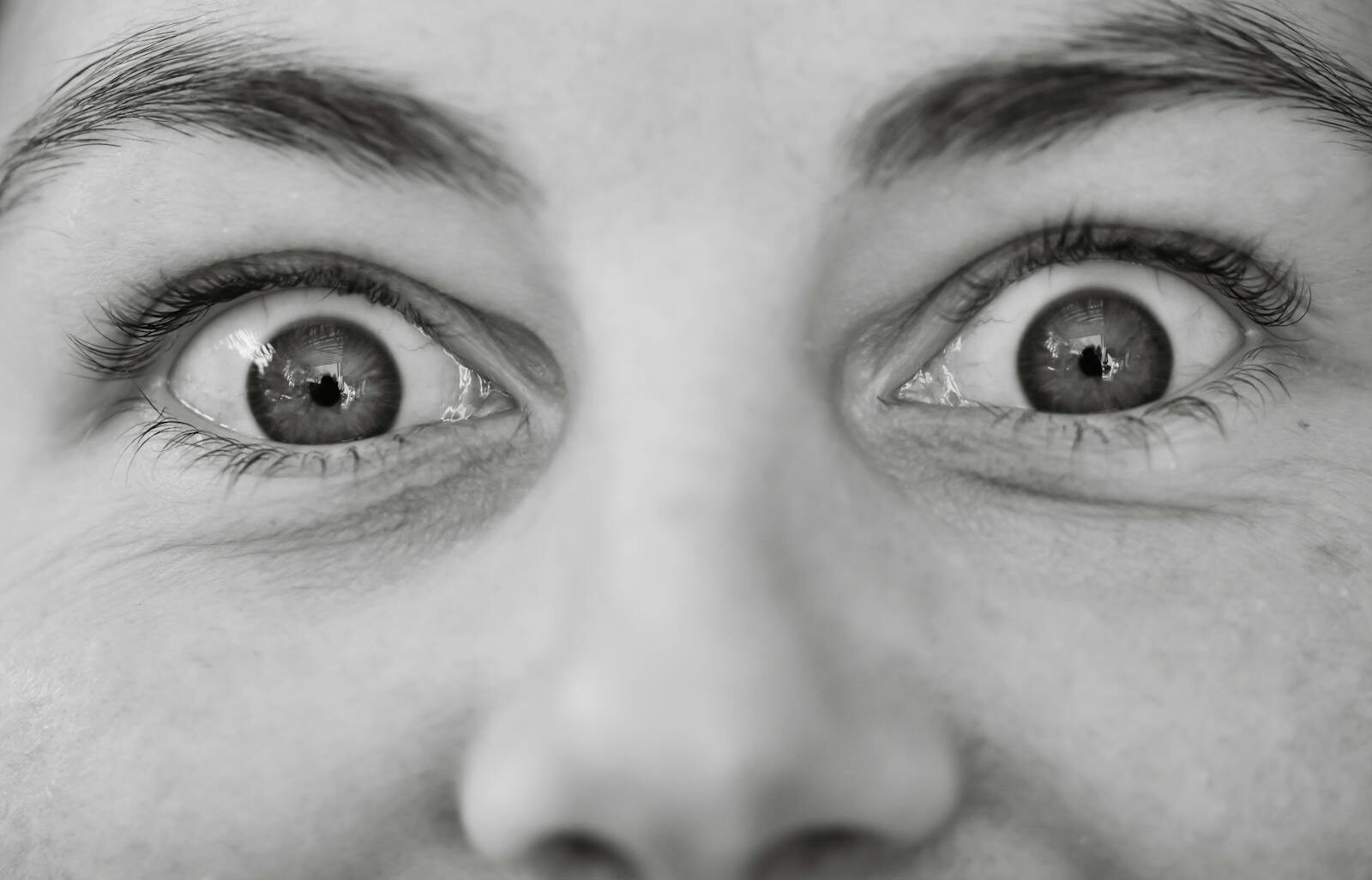
In 1960, an experimental psychologist at the University of Chicago named Eckhard Hess noticed something strange while showing his lab assistant photographs in a darkened room. The assistant’s pupils were enlarging dramatically when he looked at certain pictures. The light hadn’t changed. Something else was happening.
The result, published in Science later that year, showed that the pupils dilate involuntarily in response to emotional or sexually interesting images — a reflex with no light-based explanation. The pupils, it turned out, are wired directly to the autonomic nervous system. Subsequent work by Hess and others showed that observers respond to changes in pupil size on a face without consciously noticing. In one study, men were asked to rate two retouched photos of the same woman, identical except for pupil size. They consistently rated the version with dilated pupils as more attractive. None of them mentioned the pupils.
The trick is ancient enough that Renaissance women used belladonna — literally “beautiful lady” — to artificially dilate their pupils before social events. The plant is mildly poisonous. They used it anyway, because it worked. The signal is honest in the sense that you cannot fake it: you cannot will your pupils to dilate. When they widen at the sight of someone, your nervous system is voting on what your conscious mind hasn’t yet processed. The other person picks up the signal whether either of you intends it.
The Postural Mirroring That Builds Trust Without Conversation
Sit across from someone you genuinely like, and watch what happens with your body over the next ten minutes. If they lean forward, you’ll lean forward. If they cross their legs, yours will follow within thirty seconds. If they pick up their coffee cup, you’ll often pick up yours. This is called postural mirroring, and it operates almost entirely below conscious awareness on both sides.
Researchers have studied mirroring under laboratory conditions for decades, using video analysis to time the synchronization of small movements between conversation partners. The closer the conversational rapport, the tighter the mirroring. Therapists in good sessions mirror their clients. Couples who are in love mirror each other heavily; couples in trouble mirror much less. The brain appears to use the degree of mirroring as one of its inputs for assessing connection, which is part of why deliberately mismatched body language — leaning away, breaking the pace — registers as “off” before you can name what’s wrong.
The mirror neuron system, first identified in macaque monkeys in the 1990s by Giacomo Rizzolatti’s team at the University of Parma, fires both when an animal performs an action and when it observes another performing the same action. Whether mirror neurons fully explain the human version of this phenomenon is still debated, but the behavioral fact is well established. You are constantly synchronizing your body to the bodies around you, especially the ones you like. The synchronization itself communicates the liking — to other people, and back to your own brain, which interprets the mirroring as evidence that the encounter is going well.
The Way Your Eyes Move When You’re Remembering Versus Inventing
When people are asked questions, their eyes drift to different regions of space depending on what kind of mental work the question requires. Look up and to the left, and you’re typically accessing a visual memory. Look up and to the right, and you may be constructing a visual image you haven’t seen before. Look horizontally to either side, and the work is auditory. Look down, and you’re often processing internal emotional or kinesthetic information.
This pattern is more reliable in some people than others, and the strict left-right interpretation has been overstated in popular literature on lying. But the underlying observation is real: the eyes are connected to the brain’s information-retrieval systems in ways that produce small, consistent movements during cognition. Skilled interviewers — police, therapists, attorneys — learn to track these movements not as lie detectors but as cues to what kind of mental work the person is doing. A question that should require simple recall, answered with the eye movements of construction, is a hint that something is being assembled rather than remembered.
Observers rarely register the eye movements explicitly. They register the mismatch. A person whose eyes drift to the wrong region for the question they’re answering creates a faint sense of incongruity in the listener — the brain noting, without commentary, that the cognitive work doesn’t match the verbal output.
The Feet Pointing Away From the Conversation
Of all the parts of the body, the feet are the least monitored by conscious self-presentation. People manage their faces. They manage their hands. They almost never manage their feet — which makes their feet, paradoxically, one of the most honest signals they emit. Where the feet point is where the body actually wants to go.
Former FBI counterintelligence agent Joe Navarro, whose work on nonverbal behavior has become a reference text for interrogators, made the feet a centerpiece of his observation. In group conversations, the feet of people who are fully engaged point at one another. The feet of people who are mentally exiting point toward the door. A pair of conversation partners whose torsos appear oriented together but whose feet are angled away are signaling that one of them is preparing to leave, regardless of what they’re saying with their mouths.
This signal is processed by the people around the conversation without comment. You may have had the experience of feeling, suddenly, that the conversation is over — that the other person is “checked out” — without being able to identify what changed. Often what changed was the feet. Their owner didn’t notice. You didn’t consciously notice. But the brain saw the rotation and updated its assessment of the situation in real time.
The Tiny Drop in Blink Rate When Someone Is Lying — or Telling You the Truth
Blink rate is governed by a combination of physiological need (lubricating the eyes) and cognitive load (the brain pauses visual input during heavy mental work). At rest, most adults blink between 15 and 20 times per minute. Under stress, the rate often climbs sharply. Under intense cognitive demand — particularly when constructing a false story — the rate can briefly drop, then rebound dramatically once the task is completed.
This is part of why polygraph examiners and trained interviewers watch the eyes throughout an interrogation, not just the face. A person whose blink rate has been suppressed during a difficult question, then explodes upward immediately afterward, is showing the signature of heavy cognitive labor followed by relief. The pattern isn’t proof of deception — anxiety, fatigue, and unfamiliar questions can produce similar results — but it’s information the body is broadcasting whether the person wants to or not. Observers rarely count blinks. They notice the staring, then the flurry, then move on, having registered something that doesn’t have a name.
The Distance the Body Allows Without Saying a Word
In 1963, the cultural anthropologist Edward T. Hall published a paper introducing the term “proxemics” — the study of how humans use space as a form of communication. Hall identified four zones of personal distance, each calibrated to a different kind of relationship: intimate space (within about 18 inches, reserved for close family and romantic partners), personal space (18 inches to about 4 feet, for friends), social space (4 to 12 feet, for acquaintances), and public space (beyond 12 feet, for strangers and audiences). The distances vary by culture — Hall documented dramatically tighter intimate zones in parts of South America and the Middle East than in Northern Europe — but every culture has them, and within any given culture, people enforce them automatically.
When someone steps into a closer zone than the relationship warrants, the receiver registers it instantly. The face may stay polite. The body adjusts: a half-step back, a turn of the torso, an arm crossing the chest. None of this is decided consciously. The brain runs its proxemic calculations on every person in your immediate vicinity, every second, and adjusts your body to match. This is why crowded elevators feel so strange — they violate proxemic rules at industrial scale, forcing everyone to share intimate-distance space with strangers, which is why people in elevators almost universally stop talking and look at the floor or the ceiling. They are trying to retreat to a private zone they cannot physically retreat to.
You signal status, comfort, threat, and intimacy through the space you take and the space you allow. The other person reads the spacing without thinking. You read theirs the same way. Almost all of this happens without a word, and almost all of it lands.